Episode 321 - The Epicurean Criticism of Socrates For Denouncing Natural Science
Transcript
Section titled “Transcript”Cassius:
Welcome to episode 321 of Lucretius Today. This is a podcast dedicated to the poet Lucretius, who wrote on the Nature of Things, the most complete presentation of Epicurean philosophy left to us from the ancient world. Each week we walk you through the Epicurean texts, and we discuss how Epicurean philosophy can apply to you today. If you find the Epicurean worldview attractive, we invite you to join us in the study of Epicurus at EpicureanFriends.com where we discuss this and all of our podcast episodes.
This week we’re continuing in Book One of Cicero’s Academic Questions, where we are going through Cicero’s history of the Academy, and how the questions that were of major importance to them bled over into the general discussion of philosophy at the time of Epicurus. Last week, we focused most of our attention on Cicero’s criticism of Epicurus for allegedly saying that the good of a sheep is the same as the good of a man. We defended Epicurus on the general philosophical viewpoint that the good of all animals is to pursue pleasure and avoid pain.
This week we’re going to turn our attention to a major issue in the development of the Academy, and that is Socrates and his influence in what is often called “bringing philosophy down from the heavens.” That is an aspect of Socratic philosophy that is almost universally praised today, but was a major problem for Epicurus and the Epicureans. We’re going to discuss that in some detail, and see if we can’t draw out of that something that is not always appreciated about the significance of Epicurus’ approach to philosophy. So Joshua, why don’t we jump right into that and read section four.
Joshua:
We are starting off today in paragraph four of the first book of Academic Questions. Paragraph three was Cicero doing the majority of the speaking, and he’s going to start out paragraph four here with the words: “Then he replied,” and the “he” that is being referred to is once again Varro. So this is section four:
“Then,” Varro replied, “I will indeed consider of these matters, but only in your company, Cicero.
“But still,” said he. “What is this which I hear about you yourself?
And then Cicero replies: “On what subject? And Varro says: “Why, that the old system is deserted by you and that you have espoused the principles of the new school.”
“What of that? said Cicero. “Why should Antiochus, my own intimate friend, be more at liberty to return back again from the new school to the old then I myself to migrate to the new from the old? For certainly everything that is most recent is corrected and amended in the highest degree. Although Philo, the master of Antiochus, a great man as you yourself consider him, used to deny in his books that there were two Academies, and we ourselves have heard him assert the same thing in his lectures, and he convicts those who say that there are a palpable mistake.
And then Varro comes in for a reply here to what Cicero has just said:
“It is as you say, but I do not imagine that you are ignorant of what Antiochus has written in reply to the arguments of Philo.”
And to that Cicero says: “Certainly I am not, and I should like to hear the whole cause of the Old Academy from which I have been so long absent recapitulated by you, if it is not giving you too much trouble. Let us sit down now if you have no objection.”
And then Varro replies: “That will suit me very well, as I am not at all strong, but let us consider whether Atticus will be pleased with that compliance of mine, which I see that you yourself are desirous of.”
And then Atticus replies, “Indeed I shall, for what could I prefer to being reminded of what I long ago heard from Antiochus, and seeing at the same time whether those ideas can be expressed with sufficient suitable in Latin?
So after this preface, we all sat down looking at one another and Varro began as follows.
Cassius:
Joshua, thanks for that introduction. As usual with Cicero, he likes to set things up so we know the stage, but the basic situation is that Varro is going to be the mouthpiece for the Old Academy and take the position that there’s really not that much difference between Plato and Aristotle and even the Stoics. But we are introducing here the fact that Cicero no longer considers himself to be a member of the Old Academy. Cicero is himself embracing combinations of Stoicism with some of the reforms of Philo and others in attempting to fine tune what the Academy had been about previously. So that’s all set up for the main event, which is going to start now with Varro bringing to our attention this critical role that Socrates played in changing the course of philosophy.
Joshua:
And let’s also remember after I finish reading this what Cicero says here in response to Varro about leaving to the new and the updated version of the Academy because it’s the most current. He says it’s the most likely to be current and corrected and appropriate for people who want the most up-to-date thing. That’s an interesting claim. It’s not one you hear very often in Greek philosophy. Usually it’s “We need to go back, we need to go back to what the founders had to say” and that any innovation is necessarily a degradation. But Varro is saying, no, I want the most up to date. And so that’s something I can’t get from the Old Academy. That’s why I’ve gone from the Old Academy to the New Academy.
Cassius:
Joshua, let me go ahead and make this comment. You are certainly right to bring that up because that is highly questionable reasoning. The idea that something is correct because it is new is just as questionable as the idea that something is correct because it is old. You want to be correct because the evidence supports your argument, not because it’s the latest thing or because you’re going back to what the founders said under their circumstances. I’m glad you lingered over that because I’m surprised to hear Cicero come up with that kind of an argument. Cicero is considered to be such a traditionalist in so many ways, such a conservative as to his Stoicism, that it is pretty amazing to hear Cicero say something to the effect that the latest is the best. In fact, one of Cicero’s quotes that he’s most often identified with is, “Oh the times - oh, the morals,” as to the degradation that he thought he saw around him as the latest generation of Romans were declining from what he thought were the virtues of the past. So the more I think about it, it’s almost shocking to hear him make a statement to the effect that just because something is new, we should infer that it might be better.
Joshua:
Well, I think that covers most of what I had to say on that subject. So this is Varro speaking once again. He says, “Socrates appears to me, and it is the universal opinion, that he was the first person who drew philosophy away from matters of an abstruce character which had been shrouded in mystery by nature herself, and in which all the philosophers before his time had been wholly occupied, and to have diverted it to the objects of ordinary life, directing its speculations to virtues and vices and generally to whatever was good or bad. And he thought that the heavenly bodies were either far out of the reach of our knowledge, or that even if we became ever so intimately acquainted with them, they had no influence on living well. In nearly all his discourses, which have been reported in great variety and very fully by those who were his pupils, he argues in such a manner that he affirms nothing himself, but refutes the assertions of others.
He says that he knows nothing except that one fact: that he’s ignorant and that he’s superior to others in this particular: that they believe that they do know what they do not know. While he knows this one thing only: that he knows nothing. And it is on that account that he imagines he was pronounced by Apollo the wisest of all men. He’s talking about the Delphic Oracle at Apollo, who had said that Socrates was the wisest man in Greece, because this alone is the whole of wisdom: For a man not to think that he knows what he does not know. And as he was always saying this and persisting in the maintenance of this opinion, his discourse was entirely devoted to the praise of virtue and to encouraging all men to the study of virtue, as may be plainly seen in the books of the disciples of Socrates and above all in the books of Plato.
But by the influence of Plato, a man of vast and varied and eloquent genius, a system of philosophy was established which was one and identical, though under two names: the systems namely of the Academics and of the Peripatetics, for these two schools agreed in reality and differed only in name. For when Plato had left his nephew Speucippus the inheritor, as it were, of his philosophy, and also two pupils most eminent for industry and genius, they being Crates of Caldon and Aristotle the Stagirte, those who adhered to Aristotle were called Peripatetics because they disputed while walking into Lyceum. And the others who, according to the fashion of Plato himself, were accustomed to hold their meetings and discussions in the Academy, which is a second Gymnasium, took their name from the place where they used to meet. But both these schools being impregnated with the copiousness of Plato arranged a certain definite system of doctrine, which was itself copious and luxurious, but abandoned the Socratic plan of doubting on every subject, and of discussing everything without ever venturing on the assertion of a positive opinion.
And thus there arose what Socrates would have been far from approving of - a certain art of philosophy and methodical arrangement and division of the school, which at first, as I have already said, was one under two names. But there was no real difference between the Peripatetics and the Old Academy. Aristotle - or at least such is my opinion - was superior in a certain luxuriousness of genius. But both schools had the same source, and adopted the same division of things which were to be desired and to be avoided.
“But what am I about?” said Varro, interrupting himself? “Am I in my senses while I’m explaining these things to you, for although it may not be exactly a case of the pig teaching Minerva, still it is not very wise of anyone to attempt to impart instruction to that goddess.” So Varro ends the discussion there by saying that all of this exposition, which we know was for the audience, as it were. He’s saying that for him to explain this stuff to Cicero would be like a pig explaining it to Minerva.
Cassius:
Thanks for reading that, Joshua. It might be like a pig explaining to Minerva for Cicero to hear this, but I would estimate that very, very few of us today have an inkling of the significance of what Varro says here. We’re certainly going to spend all of today on what you’ve just read. We may have to spend several weeks on some of the issues that have been raised here, because it seems to me so important to understand what could have been the cause of the Academy splitting apart, with Aristotle going his own way, as Varro says here, with the development of something that Socrates himself would have very much disapproved of, and all of the implications that came down from that: With the Stoics deciding to go back to Socrates and look to virtue above all. With the discussion of the good going in different directions between Aristotle versus the old Academy, even though Varro says it’s essentially the same thing. And with perhaps the most important aspect of all being what Varro says Socrates would have disapproved of: because Socrates had abandoned the study of physics, abandoned the study of natural science.
Socrates was advocating the position that we should never come to a conclusion about anything. That all we could do would be to decide that we know nothing, and therefore we should spend our time deconstructing the words that other people were suggesting to be true, but never ever ourselves come to a positive conclusion. Therefore, when the Stoics came to conclusions about the nature of the universe, or Aristotle came to conclusions about the nature of the universe, that is what Varro is saying: Socrates would have disapproved. We tend to skip over that aspect of what Varo said, but think about it carefully. Because what Varro is saying is that Socrates had been taking the position that he was going to jettison the study of natural philosophy because it is impossible to come to conclusions about the way things really are. And therefore what we’re going to do instead is cross-examine each other and look for inconsistencies in our positions on ethics, so that we can finally come to the conclusion that nobody knows anything at all. And the only smart thing to say is that you don’t know anything.
Well, even that position turned out to be insufficient for the later Skeptics, but the bottom line at this point of the analysis is that there is nothing more important than understanding that Socrates had abandoned the study of natural philosophy.
That is what Epicurus fought back against as hard as he could. And instead of taking a position on whether there is a supernatural realm that governs us, that created the universe, that created mankind, that sentences man to hell or rewards him with heaven, we’re just going to talk about how to live happily, without ever giving a background definition to the way the world really is. It’s hard to overstate the importance of that conflict within these philosophical schools. It split up the academy. Aristotle would not stand for that. The Stoics also would not stand for that, because both Aristotle and the Stoics said, yes, we have to take positions on basic aspects of the universe.
Aristotle said, yes, we have to take a position that there is a prime mover. The Stoics said, yes, we have to take a position that there is a divine fire, and that’s why we’re going to reconcile ourselves with Fate from the universe.
All of those positions they knew were inconsistent with the skeptical position that Socrates would have taken, and that’s why Varro is saying that Socrates would have disapproved of this. So we need to be sure we understand the conflict that’s going on here, and not just say, “Oh wow, all these Greek philosophers are so brilliant. There’s really no difference between their positions. They’re all interested in living a good and happy life, and I’ll just go pick up a volume from Plato or any of the other non-Epicurean schools, and I’ll meditate on it and my life will automatically be better because of it.”
I don’t think Epicurus would have agreed with that whatsoever, because it is a dramatically different approach that you take when you walk away from Nature, when you walk away from the senses, and say that through the “logos,” through words, we’re going to come to a better way of life.
There’s a lot we can learn by going through these issues and discussing them. Hopefully we can move the ball a little bit in our own understanding of some of these issues that Epicurus himself was dealing with by talking about what was going on in the philosophic world around him.
So let me start where Varro praises Socrates for something that I think should be extremely controversial - where Varro says, “Socrates appears to me - and indeed it is the universal opinion - (and I would say that then it was universal and now it is universal) that Socrates had been the first person who drew philosophy away from matters of an abstruce character which had been shrouded in mystery by Nature herself, and in which all the philosophers before his time had been wholly occupied, and to have diverted it to the objects of ordinary life.”
Even that sentence we could parse to come up with some interesting things to discuss. Why would Socrates have caught something that all the other important philosophers before his time had missed? What is it about Socrates, and why did the other philosophers before him - who were not lacking in any science, it’s not like science had advanced and that Socrates had something new to work with. Why was Socrates smarter than these other earlier philosophers such as Democritus and others we may talk about later who thought that it was important to understand the nature of the universe before they decided what virtue is?
That’s going to be the major awful result of Socrates’s divergence from the prior reasoning. Now, as I say that, a true understanding of what Socrates himself really said is very difficult to come by, because Socrates did not write anything that we have today to understand exactly what his position really was. We have Plato’s statements, and we have records of Socrates from Xenophon, but we don’t have Socrates’ own writing.
So what I’m about to say in criticism of Socrates may not actually apply to Socrates. But what it does apply to is what people think Socrates taught, just as for example today we can get excited about what people think Epicurus taught, versus what Epicurus really taught. Those two can be very different. But for purposes of being practical and understanding and applying philosophy in day-to-day life, it’s important to also talk about what people think that these philosophers taught, because that’s what they’re using as the basis for their communication and understanding what those philosophers had to say. The bottom line here on this first part is that Socrates is alleged to have brought philosophy “down from the heavens.” And while that sounds great in many ways, it has tremendous implications to it, especially if you decide that: You don’t understand what’s going on in the sky above you, and you don’t understand what is going on in the planet beneath you, and you don’t understand natural science, and you don’t even think it’s important to study natural science - it’s all so confusing.
But despite all of those things that you don’t know about the nature of the universe, you are going to start making pronouncements about how to live your life virtuously. And you’re going to do it not by saying clearly the correct way to live, and explaining your reasoning, you’re going to attack the question by attacking what everybody else says, and pointing out inconsistencies that you think are there in their statements.
You’re going to start playing word games. You’re going to take what people say and try to split them apart into, “Well, they said this at one time, and they said that somewhere else - that’s inconsistent. They don’t know what they’re saying.” And you’re going to come across as the smart-alec taking the position that, “Well, I know that I don’t know anything, and that makes me smarter than everybody else. That even gets the endorsement of the Delphi Oracle of Apollo - that by means of my saying, “I don’t know anything” I am the smartest man alive.”
And when you get going down that road, it’s pretty easy to see how Socrates ends up in a lot of trouble in Athens, and how many of the leaders of his day thought that he deserved to be exiled or worse, and he ends up drinking hemlock.
But for the moment in introducing all of these issues, what Cicero has brought to our attention here is something that gets glossed over but is extremely important. Socrates essentially abandoned the study of natural science. Now I’m going to bring some references into this discussion here. One of the more recent ones that I would advise anybody who’s interested in this topic to look at would be Carl Sagan’s Cosmos series. Episode seven of that series is called “Backbone of the Night.” And in that episode, Carl Sagan gives an excellent introduction on the history of Greek philosophy, starting with an Anaxamander and going through Empedocles, praising Democrats for discussion of the atoms, and praising Anaxagorus for advances in astronomy.
But then Sagan explains to us that for some reason at that point the trend of philosophy moves in the direction of Pythagoras. Sagan says the mystics were beginning to win at that point, and that when Pythagoras starts talking about the music of the spheres and the laws of nature deduced by pure thought through mathematics and through his dodecahedron and things like that, philosophy started taking a major negative turn in abandoning natural science. Now in that Cosmos episode, Sagan does not focus on Socrates directly. He spends most of his time on Plato, but of course that’s where we understand most of what we understand about Socrates from: Plato and Plato’s representation of what Socrates thought. Sagan explains that Plato - using Socrates as his speaker - followed in the footsteps of Pythagoras and extended those footsteps into the direction of believing that ideas are more real than the natural world.
And he advised ignoring astronomy in favor of thinking; that he taught contempt for the real world and that he and his followers extinguished the light of science and experiment, with the point that unease with the world of the senses dominated and stifled Western philosophy. From that point, (again, although we’re talking Plato mostly in Carl Sagan, Socrates is right in there and is used as the speaker for Plato, so it’s hard to distinguish the two of them separately from each other), Sagan comes to the conclusion that Pythagoras and Plato provided an intellectually respectable justification for a corrupt social order. I’m going to quote from Carl Sagan for a moment here.
“Plato and Aristotle were comfortable in a slave society. They offered justifications for oppression. They served tyrants, they taught the alienation of the body from the mind, a natural enough idea, I suppose, in a slave society. They separated thought from matter; they divorced the earth from the heavens - divisions, which were to dominate Western thinking for more than 20 centuries. The Pythagoreans had won. The books of the Ionian scientists are entirely lost. Their views were suppressed, ridiculed, and forgotten by the Platonists and by the Christians who adopted much of the science of Plato.
And again, it’s fair - every time you hear Plato - you can largely substitute Socrates, so that the issue that Cicero is bringing up in what we’re reading in this material from Varro, I would submit, is very much the same issue that Carl Sagan is attacking in his Cosmo series. Now, to go a little further, let me list a couple of other references here.
In Plato’s Apology, Socrates’ defense speech, Socrates explicitly denies the popular accusation that he was a natural philosopher who investigated things in the sky and below the earth. Socrates says he had no interest in or expertise in such matters. So in Plato’s Apology, Socrates insists that his real activity was questioning people about moral and ethical concepts. So there in Plato’s Apology we have Socrates distancing himself from the study of natural science.
in Plato’s Phaedo, which is set on the day of Socrates’ death, Socrates gives a more autobiographical account. As a young man, Socrates had been enthusiastic about natural philosophy, and eagerly studied the works of pre-Socratic thinkers hoping to discover the true causes of things like why things grow and why the earth is shaped like it is, and what makes the universe orderly. But Socrates became disillusioned when these materialistic explanations such as from Anaxagorus, which failed to provide satisfying answers to him. And so Socrates abandoned that path as futile and misguided for human concerns, and turned instead to examining human life ethics and the soul through dialectical questioning. And Socrates call that his “second sailing,” a turn to logos or reasoned discourse rather than empirical and physical investigation. And to back it up even further, in Xenophon’s Memorabilia, Xenophon also says that Socrates did not discuss the nature of the universe or speculation about the cosmos as others did. Socrates reportedly argued that such inquiries were foolish. Humans should focus on what is within their grasp, which is according to Socrates, human affairs, ethics and practical wisdom while leaving divine or cosmic matters to the gods via divination if needed. And Socrates saw preoccupation with unreachable questions as neglect of more urgent human ones.
Now in terms of the Epicurean texts on this topic, one of the most direct statements of the problem with Socrates comes in Diogenes of Oinoanda. In the inscription on his wall in fragment four and five, Diogenes says this, criticizing some of the philosophers and especially the Socratics I’m quoting here: “They say that pursuing natural science and busying oneself with investigation of celestial phenomena is superfluous and unprofitable and they do not even deign to concern themselves with such matters. Others do not explicitly stigmatize natural science as unnecessary, being ashamed to acknowledge that, but they use another method of discarding it. For when they assert that things are incomprehensible, what else are they saying than there is no need for us to pursue natural science? After all, who will choose to seek what he can never find? Now, Aristotle and those who hold the same Peripatetic views as Aristotle, say that nothing is scientifically knowable because things are continually in flux, and on account of the rapidity of the flux evade our apprehension. We (speaking of the Epicureans) on the other hand, acknowledge their flux, but not its being so rapid that the nature of each thing is at no time apprehensible by sense perception. And indeed, in no way would the upholders of the view under discussion have been able to say, and this is exactly what they do maintain, that at one time this is white and that is black, while at another time neither this is white nor that is black, if they had not previous knowledge of the nature of both black and white.
So here I’ve seen people argue back and forth about whether this is accurate as to Aristotle or not. But in terms of the Aacademy in general, it’s clear that the criticism Diogenes is raising on behalf of the Epicureans is that the Socratics and those who followed after them had dismissed the importance of studying natural science, and said that it was unnecessary and even counterproductive to do so.
Now I’ll cite several more instances where Epicurus is very clear that it is important to discuss natural science, that you can’t live happily, you can’t get rid of the anxiety about your place in the universe, unless you understand the universe. So here’s a couple of citations from Epicurus starting with the letter to Herodotus around line 37: “Wherefore, since the method I have described is valuable to all those who are accustomed to the investigation of nature, I who urge upon others the constant occupation in the investigation of nature and find my own peace chiefly in a life so occupied, have composed for you another epitome on these lines, summing up the first principles of the whole doctrine.”
In Principal Doctrine number 11, Epicurus says, “Were we not upset by the worries that celestial phenomena and death might matter to us, and also by failure to appreciate the limits of pain and desires, we would have no need for natural philosophy.” Of course, we are upset by those things, and so therefore we do have need of natural philosophy - I think is the clear implication of Principal Doctrine 11.
Principal Doctrine 12 continues the same thought: “There is no way to dispel the fear about matters of supreme importance for someone who does not know what the nature of the universe is, but retains some of the fears based on mythology. Hence, without natural philosophy, there is no way of securing the purity of our pleasures.”
Principal Doctrine 13 says, “There is no benefit in creating security with respect to men while retaining worries about things up above things beneath the earth and generally things in the infinite.
Vatican Saying 45 says that it is natural philosophy which does not make people boastful and loudmouthed nor flaunters of culture, the things so hotly competed for among the multitude, but which makes people modest and self-sufficient and proud at their own goods, not at those of their circumstances.
And of course, throughout Lucretius we have the emphasis on natural philosophy and the study of nature, which is a criticism that Lucretius often comes under from people who study Epicurus. They say, why does Lucretius spend so much time talking about atoms and voids and images and magnetism and clouds and rain and snow and so forth?
It’s because Epicurus taught that the study of nature is the foundation for your having confidence in understanding how to do anything else. Epicurus is not going to be like Socrates and say, “I don’t know anything about anything, but I’m happy to give you information on how you should live your life.” Epicurus is not going to take that “I don’t know anything” position and smugly say that because I don’t know anything. I’m smarter than you are, and that in fact the gods have told me that I’m smarter than you are because I know nothing, and you’re so dumb that you think you know a few things.
Epicurus is taking the opposite position here, and this has tremendous implications on the development of Epicurean philosophy in a separate direction from that which Socrates and Pythagoras and Plato ended up deprecating, by looking to ideal forms to the extent they wanted to explain anything, and looking straight to Virtue as the Stoics do, rather than looking to natural science and checking all your conclusions by what nature tells you, including pleasure, pain, anticipations, and the five senses. That becomes the gold standard for action according to Epicurus, when you put natural science in its proper place as opposed to word games, which becomes the load stone for Socrates when he says, “I don’t know anything and it’s impossible to know anything.”
Joshua:
Those points are well made, Cassius. As usual, my own personal hobby-horse of geometry and its misuse by everyone from Pythagoras on upwards is in many ways central to this question. It was precisely the structure and clarity of geometry that allowed these men, that permitted them to think that nature so obscure was a second rate study by comparison. And so most of what I’ve gathered to talk about today is on that point.
The first place to go is to Plato’s Republic, and this is Socrates in dialogue with the interlocutor, and he’s just explained the allegory of the cave. And the problem now is how does the would-be philosopher find their way out of the cave? And with the interlocutor, Socrates is going through a number of different options and they look at: “Well, what about athleticism or wrestling or a foot race or whatever? Are those skills going to be transferable?” And they decide, well, probably not. What about the military? The things that we learned as soldiers? Socrates was a soldier before he was a philosopher. Are these things going to be useful? And what they come up with is you can’t rely on the gymnasium, you can’t rely on Greek drama (comic or tragic). You can’t rely on epic poetry. You can’t rely on any of these cultural apparatus that surrounds and sustains their Greek culture. What you have to rely on is geometry, and he’s going to make that point here. Socrates says, while discussing this problem of what should we use, what should we do in order to get our way out of the cave?
He says this. He says, think a little and you’ll see that what is proceeded will supply the answer for a simple unity could be adequately perceived by the sight or by any of the other senses, then as we were saying in the case of the finger, there would be nothing to attract towards being. That’s the whole problem with the cave, is you’re in the world of becoming in the cave where things are constantly in flux. You’re trying to get out of the cave and ascend into the realm of ideal forms into the world of pure and perfect being - a world that’s not in flux and where the perfect geometric forms are the pattern for things that exist in the world of the flux, but only as corruptions of the forms as he goes on to say. But when there is some contradiction always present, and one is the reverse of one and involves the conception of plurality, then thought begins to be aroused within us and the soul perplexed and wanting to arrive at a decision asks, “What is absolute unity?” This is a way in which the study of the one has a power of drawing and converting the mind to the contemplation of true being.
That’s why mathematics and particularly geometry is going to give us the answer. But the question is, what kind of mathematics? And so they raised this other problem, which is this knowledge of the kind for which we are seeking, having a double use, military as well as philosophical. But the man of war must learn the art of number, the art of arithmetic, or he will not know how to array his troops. And the philosopher also, because he has to rise out of the sea of change, the sea of becoming, and lay hold of true being and therefore he must be an arithmetician. And then Socrates says, now having spoken of it, I must add how charming the science is and in how many ways it conduces to our desired end if pursued in the spirit of a philosopher and not of a shopkeeper. That’s a key point to keep in mind here, which is we are exclusively, and by we I mean not me, Socrates and Pythagorus and the rest of them, they’re exclusively interested in geometry as an abstract, intellectual, cerebral exercise.
They have no interest in the practical applications - that’s going to get important as they go further here. But you need to think about these things as a philosopher and not as a shopkeeper, tallying up your revenue for the day. He goes on to say that those who have a natural talent for calculation are generally quick at every other kind of knowledge. And even the dull, if they have had an arithmetical training, although they may derive no other advantage from it, always become much quicker than they would otherwise have been. And that leads them to the point that arithmetic is a kind of knowledge in which the best nature should be trained and which must not be given up. Let this then be made one of our subjects of education and next shall we inquire whether the kindred science also concerns us. So now we’re getting into specifically geometry.
We’ve been talking about arithmetic and calculation and so on. And so they bring up the issue of geometry and Socrates says, exactly, so that’s exactly where we’re going next. And the student says, clearly we are concerned with that part of geometry which relates to war. We’re in pitching a camp, we’re taking up a position or closing or extending the lines of an army or any other military maneuver, whether in actual battle or on a march, it will make all the difference whether a general is or is not a geometricion. And Socrates replies, he says, yes, but for that purpose, a very little of either geometry or calculation will be enough. You don’t need much to figure out how to arrange your troops into a row. The question relates rather to the greater and more advanced part of geometry, whether that tends in any degree to make more easy the vision of the idea of good and thither.
As I was saying, all things tend which compel the soul to turn her gaze towards that place where is the full perfection of being, which she ought by all means to behold. And the student agrees with this. And then Socrates said then: If geometry compels us to view being, it concerns us. If it compels us to view becoming only, it does not concern us. In other words, in so far as geometry relates to the sensory world where things are constantly in flux, it is completely useless to our studies. In so far as geometry relates to the world of pure being - the world that we aspire to as good socratics and pythagoreans and platonists. Only then is it useful to us. And in service of that end, Socrates will go on a little bit later here in the text to say that the knowledge at which geometry aims is knowledge of the eternal. That’s why we’re cleaving to this. That’s why this is going to be the thing that gets us out of the cave. And it was this view that allowed these thinkers to - when they did bother to approach nature - to approach it through the lens of a geometrical framework. And this is why the Pythagoreans developed a cosmos based on pure numbers. They reasoned that because a point is one and a line is two points. A surface can be made with three points to form a triangle, and a solid or a volume can be made with four points to form a pyramid. They arrived at the sacred and omnipotent total number of 10. I’m reading here from a book called “The Rise and Fall of Alexandria” by Justin Pollard and Howard Reed. They believed that 10 would also be the key to understanding the structure of the cosmos. So they had this view that the earth was at the center of a series of concentric rings, and that the orbit of one planet would constitute one ring.
And it was because of geometry, not because of their observations of nature. It was because of geometry that they arrived at the conclusion that there were 10 of these rings. And you could very well say, well, nine planets including Pluto plus the sun plus the moon, they’re pretty close to 10 there. They seem to have struck upon something here. But the thing is they couldn’t see any planets that were not visible to the naked eye at this point in time, right? They didn’t have telescopes that would allow them to see that far out. So it wasn’t that they observed the planets and planetoids and came up with the number that way. They started with the assumption that geometry and the claims of geometry and the pureness and sublimity and clarity of geometry had to be reflected in nature. And it was that error that led them into the belief that they have since become very well known for, with its at attendant idea of the music of the spheres and so on.
There is one other place to go here, and this was the siege of Syracuse by the Roman Republic as part of the broader second Punic war between Rome and Carthage in two 13 to two 12 bc. And the Romans were led by a pro console named Marcellus and Plutarch wrote a Life of Marcellus. So everything I’m about to say now comes from that book by Plutarch, he says, but in Sicily at the time of which I speak, the commander of the Syracuse ones was to take a separate city by storm. And he goes on to say upon this, Marcellus set out with his whole army and came to Syracuse. So this is the problem. The Syracuse ones were kind of neutral in the Punic wars, but they also would kind of lean toward one side or another depending on who they thought would win.
And it was the attempt to take the city of Liantini that put them under the eye of the Roman pro console, Marcellus and his army and this siege between the Roman proconsul and the Syracusan philosopher and geometer Archimedes has become very famous because it suggests differences in their cultural outlooks and their technology and so on. Plutarch says that Marcellus had erected an engine of artillery on a huge platform supported by eight galleys fastened together. And so the seige engines they used were partially on land, but partially on water, because Syracuse is on the coast. Plutarch says, “But all this proved to be of no account in the eyes of Archimedes. And in comparison with the engines of Archimedes to these, he had by no means devoted himself as work worthy of his serious effort, but most of them were mere accessories of a geometry practiced for amusement. Since in bygone days, king Hiro had eagerly desired and at last persuaded him to turn his art somewhat from abstract notions to material things.”
Here we have this dilemma again, what do you focus on? What do you choose to focus on? And Archimedes wants to focus on the same thing that Pythagorus, who also lived for a time on the island of Sicily wanted to focus on that. Plato wanted to focus on that. Socrates wanted to focus on - we want to focus on the cerebral and mental aspects of the question, and we want to turn our attention away from the merely sensory or the merely material. But war is going to make that very difficult for our communities. And by applying his philosophy somehow to the needs which makes themselves felt, that’s the key point - that the needs of war could not be put aside and to render it more evident to the common mind.
That’s why he engages in making these sort of geometrical toys is to make it easier for people to understand. Plutarch goes on to say this,“But the art of mechanics now so celebrated and admired was first originated by Eudoxus and Architus, who embellished geometry with its subtleties and gave to problems incapable of proof by word and diagram, a support derived from mechanical illustrations that were patent to the senses. Let me explain that for a little bit here. The problem is you’ve got some problems in geometry that can’t be proved like squaring the circle or doubling the cube that with the rules available to them at the time, the axioms of geometry available to them at the time, they weren’t able to solve according to the precise understanding of these problems. But there were people like Eudoxus and Architus who were willing to bring the world of the sensory and the material as auxiliaries to support them in this problem in geometry.
And this to someone like Plato or Socrates or Pythagoras, this is a betrayal of everything that geometry stands for. Pluto says, for instance, in solving the problem of finding two mean proportional lines, a necessary requisite for many geometrical figures, both mathematicians had recourse to mechanical arrangements adapting to their purposes certain intermediate portions of curved lines and sections. And he says, but Plato was incensed at this and enveighed against them as corruptors and destroyers of the pure excellence of geometry, which thus turned her back upon the incorporeal things of abstract thought and descended to the things of sense, making use moreover of objects, which required much mean and manual labor. For this reason, mechanics was made entirely distinct from geometry, and being for a long time ignored by philosophers came to be regarded as one of the military arts. And I think that is an excellent description by Plutarch of the nature of the problem.
He then gives a long description of how the siege proceeded, and I’m going to skip over all that and I’m going to come to what Plutarch has to say about Archimedes. And he says this. He says, “Archimedes possessed such a lofty spirit, so profound a soul and such a wealth of scientific theory that although his inventions had won for him a name and fame for superhuman sagacity, he would not consent to leave behind him any treatise on this subject. But regarding the work of an engineer and of every art that ministers to the needs of life as ignoble and vulgar, he devoted his earnest efforts only to those studies, the subtlety and charm of which are not affected by the claims of necessity. These studies he thought are not to be compared with any others in them. The subject matter vies with the demonstration, the former supplying grandeur in beauty, the latter precision and surpassing power. For it is not possible to find in geometry more profound and difficult questions treated in simpler and pure terms.”
Plutarch continues, “For no one could by his own efforts discover the proof, and yet as soon as he learns it from him, he thinks he might have discovered it himself. So smooth and rapid is the path by which he leads one to the desired conclusion. And therefore, we may not disbelieve the stories told about him, how under the lasting charm of some familiar and domestic siren, he forgot even his own food and neglected the care of his person, and how when he was dragged by main force, as he was often to the place for bathing and the anointing of his body, he would trace geometrical figures in the ashes and draw lines with his finger in the oil with which his body was anointed, being possessed by a great delight and in very truth a captive of the muses. And although he made many excellent discoveries, he has said to have asked his friends and kinsman to place over the grave where he should be buried a cylinder enclosing a sphere with an inscription giving the proportions by which the containing solid exceeds the contained.”
And it was based on this description of the grave of Archimedes that Cicero himself, what he was quester in Sicily, was able to rediscover the lost grave of Archimedes. That was a lot of reading today of other texts. But you see the key point here, it’s that not only are we disregarding the study of nature, the sense that we get from these accounts and these anecdotes is we are disregarding anything that has to do with the world of sense perception, and the world of mere material. Anything that has to do with the constraints of necessity, the necessities of life, including in the case of Archimedes, he forgets to eat because he’s so caught up in his geometric studies. And it’s this notion that the world of pure becoming that we can imagine in our mind expressed through the axioms and rules of pure clear geometry, that this is the only really pure pursuit uncorrupted by physical demonstration as we see from Plato there that is fit for a philosopher. and that it was this that they would use to support their ethical claims and their political claims and their claims about nature, as we saw with the Pythagoreans and the number of spheres in the heaven.
So comparing this set of thinkers with Epicurus, the difference almost could not be more stark, because Epicurus’ whole world is the world of the sensory and the world of the material, and he doesn’t have time for this kind of naval gazing pursuit of geometry where everything happens in your mind and nothing useful ever happens in the real world.
Cassius:
Yes, Joshua, we’re going to run out of time to go further today, so I’m going to bring us to a conclusion and we will resume this next week. But I want to emphasize that what Joshua has just told us about Archimedes ought to illustrate the significance of this problem. A mind as brilliant as Archimedes, who could do so much through his knowledge of geometry, thought that nevertheless, that knowledge of geometry was not worth passing on, that it was largely beneath his dignity to actually use geometry for something practical. And instead, he has bought into this Pythagorean, Socratic, Platonic, Stoic nonsense that there is some other world out there that takes precedence over this one. I’m going to conclude by again referring people to the Carl Sagan episode about Plato, and this direction in Greek philosophy, because we in this podcast try to be nice and try to look at things from an accommodating point of view, and try not to be too overwrought in describing some of these issues.
But Carl Sagan does not hold back in his condemnation of what we’re talking about here today. And we need to understand the practical implications that this is not just some tea party talk, it’s not just total abstraction. It leads to practical results that need to be understood before you decide to follow one path or the other. You can look at it in terms of wanting to live happily, and understanding that Epicure said you can’t live happily without natural science.
But there are many more implications beyond just that summary that Carl Sagan does a good job of synopsizing for us, that is explicit in the writings of Epicurus, that is explicit in the writings of Lucretius, that is explicit in the denunciation that Diogenes of Oinoanda spoke about as opposed to the Socratics. And believe it or not, that’s only really half of the Epicurean criticism of Socrates because we haven’t even begun to address the Epicurean criticism of Socrates not being clear about his positions and the way that Socrates related to his students, which is the subject of an essay called “The Epicurean Criticism of Socrates,” an Academic article that we will discuss at least briefly next week at the moment.
Let’s stop. As always, we invite everyone to drop by the EpicureanFriends forum and let us know if you have any questions or comments about this or other discussions of Epicurus. We will be back next week to pursue this further. Until then, thanks for your time today. Bye.
Reference to Lucian’s statements in “Alexander the Oracle Monger”
Section titled “Reference to Lucian’s statements in “Alexander the Oracle Monger””Picture to yourself a little chamber into which no very brilliant light was admitted, with a crowd of people from all quarters, excited, carefully worked up, all aflutter with expectation. As they came in, they might naturally find a miracle in the development of that little crawling thing of a few days ago into this great, tame, human-looking serpent. Then they had to get on at once towards the exit, being pressed forward by the new arrivals before they could have a good look. An exit had been specially made just opposite the entrance, for all the world like the Macedonian device at Babylon when Alexander was ill. He was in extremis, you remember, and the crowd round the palace were eager to take their last look and give their last greeting. Our scoundrel’s exhibition, though, is said to have been given not once, but many times, especially for the benefit of any wealthy new-comers.
And at this point, my dear Celsus, we may, if we will be candid, make some allowance for these Paphlagonians and Pontics. The poor uneducated ‘fat-heads’ might well be taken in when they handled the serpent—a privilege conceded to all who choose—and saw in that dim light its head with the mouth that opened and shut. It was an occasion for a Democritus, nay, for an Epicurus or a Metrodorus, perhaps, a man whose intelligence was steeled against such assaults by scepticism and insight, one who, if he could not detect the precise imposture, would at any rate have been perfectly certain that, though this escaped him, the whole thing was a lie and an impossibility.
Carl Sagan’s Cosmos Episode 7 “Backbone of the Night”
Section titled “Carl Sagan’s Cosmos Episode 7 “Backbone of the Night””- Start about the 20 minute mark
- 25:00 - Anaximander and evolution (positive)
- 26:27 - Empedocles discovers air; discussion of “water thief” (positive)
- 28:36 - Democritus and atoms (positive)
- 33:30 - Anaxagorus advances in astronomy but was persecuted (positive)
- 34:13 - Pythagorus “The mystics were beginning to win” - continuity between him and Christianity. Mathematical harmony underlies all of nature - “music of the spheres” - “cosmos means ‘ordered.’ Pythagorus said laws of nature deduced by PURE THOUGHT - they were mathematicians and thoroughgoing mystics- the dodecahedron - ordinary people to be kept ignorant of the dodecahedron - they suppressed knowledge of the square root of two as “irrational” Pythagoreans ignored “experiment” (highly negative)
- 39:07 Plato — Followed in steps of Pyathagorus and extended them - ideas are more real than the natural world - advised ignoring astronomy in favor of thinking - taught contempt for the real world - he and his followers extinguished the light of science and experiment. Unease with the world of the senses and dominated and stifled western philosophy.
- 40:44 - Pythagorus and Plato “provided an intellectually respectable justification for a corrupt social order.""
- 41:13 - “Plato and Aristotle were comfortable in a slave society. Thy offered justifications for oppression. They served tyrants. They taught the alienation of the body from the mind - a natural enough idea I suppose in a slave society. They separated thought from matter. They divorced the earth from the heavens. Divisions which were to dominate western thinking for more than 20 centuries. The Pythagoreans had won. … The books of theionian scientsts are entirely lost. Their views were suppressed, ridiculed and forgotten by the Platonists and by the Christians who adopted much of the science of Plato.
Grok Commentary
Section titled “Grok Commentary”What was Socrates’ position on whether it is important to study natural science and the nature of the universe?
Socrates did not consider the study of natural science (what the ancient Greeks called physis or inquiries into the nature of the cosmos, astronomy, meteorology, the elements, and the physical causes of phenomena) to be important or worthwhile for human life — at least not as a primary pursuit.He famously shifted the focus of philosophy away from these cosmological and physical speculations — which had dominated earlier thinkers like Thales, Anaximander, Anaximenes, Heraclitus, and Anaxagoras (the so-called pre-Socratics) — toward ethics, the examination of human affairs, virtue, justice, piety, and how one ought to live.Key Evidence from Primary Sources
In Plato’s Apology (Socrates’ defense speech at his trial), he explicitly denies the popular accusation that he was a natural philosopher who investigated “things in the sky and below the earth.” He says he has no interest in or expertise in such matters and that the charge stems from a caricature (like Aristophanes’ comedy The Clouds, which mocks him as someone dangling in a basket measuring fleas and speculating about celestial phenomena). Socrates insists his real activity is questioning people about moral and ethical concepts in the marketplace.
In Plato’s Phaedo (set on the day of Socrates’ death), he gives a more autobiographical account: As a young man, he was enthusiastic about natural philosophy and eagerly studied the works of pre-Socratic thinkers, hoping to discover the true causes of things (e.g., why things grow, why the earth is shaped as it is, or what makes the universe orderly). He became disillusioned when these materialistic explanations (e.g., Anaxagoras’ “Mind” as a cosmic force) failed to provide satisfying answers, especially about why things are ordered for the best or good. He abandoned this path as futile or misguided for human concerns and turned instead to examining human life, ethics, and the soul through dialectical questioning. He calls this his “second sailing” — a turn to logos (reasoned discourse) rather than direct empirical or physical investigation.
In Xenophon’s Memorabilia (another student’s account of Socrates), Xenophon defends Socrates against similar charges by stating that he did not discuss “the nature of the universe” or speculate about the cosmos “as the others did.” Socrates reportedly argued that such inquiries were foolish: humans should focus on what is within their grasp (human affairs, ethics, practical wisdom), while leaving divine or cosmic matters to the gods (via divination if needed). He saw preoccupation with unreachable questions as neglect of more urgent human ones.
Why This Shift? Socrates believed true wisdom and the good life lie in self-knowledge (“know thyself”) and understanding moral concepts like virtue (which he often treated as a kind of knowledge). Speculating about the physical universe or its material causes did little to improve one’s character or make one a better person — it could even distract from ethical living or lead to impiety if it undermined traditional reverence for the divine order. He viewed the cosmos as intelligently ordered (with hints of divine design in Xenophon), but probing its mechanics mechanistically was not the path to virtue or happiness.In short, Socrates regarded the study of natural science and cosmology as largely unimportant — even potentially misguided — for the serious pursuit of wisdom and a good life. He prioritized the human realm (ethics, the soul, and moral improvement) over the natural one. This “Socratic turn” profoundly influenced later philosophy, marking a pivot from pre-Socratic naturalism to ethical and metaphysical inquiry in Plato and beyond.
Confirmed as the common view by Chatgpt:
What was Socrates’ position on whether it is important to study natural science and the nature of the universe?
In the ancient sources, Socrates is consistently portrayed as downplaying the importance of studying natural science and the physical structure of the universe, especially when compared with ethical inquiry.
According to Plato’s Apology, Socrates explicitly denies engaging in investigations “in the sky or below the earth,” distancing himself from the natural philosophers (physikoi) who speculated about cosmology, astronomy, and the ultimate constituents of matter. He presents this denial not merely as a defense against specific charges, but as a principled statement of his philosophical priorities. For Socrates, inquiry into nature was both uncertain and largely irrelevant to the central human task.
Socrates held that the most important questions concern how one ought to live: the nature of virtue, justice, piety, and the proper care of the soul. He believed that studying the cosmos does not reliably improve moral character and may even distract from self-knowledge. This stance is reinforced by later testimonies (such as those in Xenophon), which depict Socrates as skeptical that cosmological speculation yields practical or ethical benefit.
In short, Socrates did not regard the study of natural science or the nature of the universe as intrinsically valuable. He deliberately redirected philosophy away from cosmology and toward ethics, holding that understanding how to live well is far more important than understanding how the universe is structured.
More detail and specific reference to Epicurus from Claude:
Socrates famously argued against the importance of studying natural science and cosmology, representing a major shift in Greek philosophy from the natural philosophers (like Thales, Anaximander, and Democritus) who preceded him.
In Plato’s Apology, Socrates explicitly distances himself from natural philosophy when defending against charges. He denies investigating “things in the sky and below the earth,” stating he has no knowledge or expertise in such matters (Apology 19b-c).
In Plato’s Phaedo, Socrates describes his youthful interest in natural philosophy and his ultimate disappointment with it. He found that explanations based on material causes (like Anaxagoras’s system) failed to answer the questions that truly mattered to him - questions about purpose, goodness, and why things are as they should be (Phaedo 96a-99d).
Xenophon’s Memorabilia (IV.7) records Socrates actively discouraging students from studying astronomy, geometry, and other natural sciences beyond what’s practically necessary. He argued that such studies were:
- Endless and possibly futile
- A distraction from more important matters
- Less valuable than self-knowledge and ethical inquiry
Cicero famously credited Socrates with bringing “philosophy down from the heavens” and making it concerned with human life, ethics, and how one should live (Tusculan Disputations V.10).
Socrates’ Alternative Focus:
Instead, Socrates insisted on the priority of self-knowledge (“Know thyself”) and ethical questions about virtue, justice, and the good life - what he considered truly important for human flourishing.
This represents a stark contrast with later philosophers like Epicurus, who considered natural science essential for removing fear and superstition.
Diogenes of Oinoanda Fragments 4 and 5:
Section titled “Diogenes of Oinoanda Fragments 4 and 5:”Fr. 4
… [as is supposed by] some of the philosophers and especially the Socratics. They say that pursuing natural science and busying oneself with investigation of [celestial phenomena] is superfluous and unprofitable, and they do [not even] deign [to concern themselves with such matters.]
Fr. 5
[Others do not] explicitly [stigmatise] natural science as unnecessary, being ashamed to acknowledge [this], but use another means of discarding it. For, when they assert that things are inapprehensible, what else are they saying than that there is no need for us to pursue natural science? After all, who will choose to seek what he can never find?
Now Aristotle and those who hold the same Peripatetic views as Aristotle say that nothing is scientifically knowable, because things are continually in flux and, on account of the rapidity of the flux, evade our apprehension. We on the other hand acknowledge their flux, but not its being so rapid that the nature of each thing [is] at no time apprehensible by sense-perception. And indeed [in no way would the upholders of] the view under discussion have been able to say (and this is just what they do [maintain] that [at one time] this is [white] and this black, while [at another time] neither this is [white nor] that black, [if] they had not had [previous] knowledge of the nature of both white and black.
Epicurus, Letter to Herodotus 37
Section titled “Epicurus, Letter to Herodotus 37”Wherefore since the method I have described is valuable to all those who are accustomed to the investigation of nature, I who urge upon others the constant occupation in the investigation of nature, and find my own peace chiefly in a life so occupied, have composed for you another epitome on these lines, summing up the first principles of the whole doctrine. (Bailey)
Epicurus, Principal Doctrine 11
Section titled “Epicurus, Principal Doctrine 11”Were we not upset by the worries that celestial phenomena and death might matter to us, and also by failure to appreciate the limits of pains and desires, we would have no need for natural philosophy. (L&S-THP)
Epicurus, Principal Doctrine 12
Section titled “Epicurus, Principal Doctrine 12”There is no way to dispel the fear about matters of supreme importance, for someone who does not know what the nature of the universe is but retains some of the fears based on mythology. Hence without natural philosophy there is no way of securing the purity of our pleasures. (L&S-THP)
Epicurus, Principal Doctrine 13
Section titled “Epicurus, Principal Doctrine 13”There is no benefit in creating security with respect to men while retaining worries about things up above, things beneath the earth, and generally things in the infinite. (L&S-THP)
Epicurus, Vatican Saying 29
Section titled “Epicurus, Vatican Saying 29”I would rather speak with the frankness of a natural philosopher, and reveal the things which are expedient to all mankind, even if no one is going to understand me, than assent to the received opinions and reap the adulation lavishly bestowed by the multitude. (L&S-THP)
Epicurus, Vatican Saying 45
Section titled “Epicurus, Vatican Saying 45”Natural philosophy does not make people boastful and loud-mouthed, nor flaunters of culture, the thing so hotly competed for among the multitude, but modest and self-sufficient, and proud at their own goods, not at those of their circumstances. (L&S-THP)
Lucretius 1.62-79
Section titled “Lucretius 1.62-79”(1) When human life lay foul to see and groveling upon the ground, crushed by the weight of Religion, who displayed her head from the regions of heaven, lowering over mortals with horrible aspect, (2) a man of Greece dared first to raise his mortal eyes against her, first to make a stand against her; for neither fables of the gods could quell him, nor thunderbolts, nor heaven with menacing roar, but all the more they goaded the eager courage of his soul to long to be the first to burst through the close-set bolts of nature’s gates. (3) Therefore his vigorous mind won through, and he passed on far beyond the fiery walls of the world, and in mind and spirit traversed the boundless universe; (4) whence returning victorious he reports to us what can arise, what cannot, and by what principle each thing has its powers limited and its deep-set boundary stone. (5) Therefore Religion is now in turn cast down and trampled underfoot, while we by the victory are exalted high as heaven. (L&S-THP)
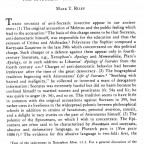
Riley - The Epicurean Criticism of Socrates
Section titled “Riley - The Epicurean Criticism of Socrates”