
Let All Who Would Free Themselves From the False Claims Of The Geometers Enter Here
Introduction: Two Inscriptions Over Two Doors
Section titled “Introduction: Two Inscriptions Over Two Doors”Over the entrance to Plato’s Academy in Athens, tradition records an inscription: “Let no one ignorant of geometry enter here.” The words were more than a subject requirement. They were a philosophical manifesto. The world as it truly is, Plato held, cannot be grasped by those who have trained only on the deliverances of sense experience. The student who can see, touch, and measure the physical world is not yet prepared to understand reality. First he must learn to reason about points without dimension, lines without width, planes without depth — entities that have no counterpart in anything sensation can deliver, but which are, in the Platonic view, more real than anything sensation can reach. Geometry was the training ground for the soul’s ascent from the visible world to the intelligible one. To enter without it was to arrive not yet ready to learn what mattered.
As it happens, Epicurus did have an inscription at the entrance to his Garden — or so Seneca reports. In Epistle 21 of the Epistulae Morales, Seneca records what he calls the motto carved there: “Stranger, here you will do well to tarry; here our highest good is pleasure.” Scholars note that Seneca may be speaking at least partly metaphorically, but his phrase “the motto carved there” (ibi insculptum) suggests he understood this as an actual inscription on the garden gate, and it has been treated as such throughout the history of the school. The Latin text he records — hospes hic bene manebis hic summum bonum voluptas est — has the compressed character of something chiseled rather than something spoken. Whatever the historical truth of the inscription itself, the sentiment it expresses is unimpeachably Epicurean: the announcement, without apology or qualification, that pleasure is the highest good, placed at the very threshold of the school as the first thing a visitor encountered.
That announcement was the Garden’s direct challenge to the Academy down the road. Where Plato’s inscription demanded submission to abstract geometry as the precondition for philosophical understanding, Epicurus’s announced something diametrically opposed: that pleasure — the real, felt, experienced pleasure of a life lived in accordance with nature — was the goal, not the ascent toward eternal mathematical abstractions that could never be touched, tasted, or seen. The Garden’s motto was a philosophical statement, not merely a social one.
But the philosophical opposition between the Garden and the Academy ran deeper still, into questions about what kind of things exist and how we can know them. If Epicurus had inscribed a second motto alongside the first — one that announced the epistemological precondition for seeing the world as it actually is, rather than as the geometers claimed — it might have read something like the title of this article: “Let All Who Would Free Themselves From the False Claims of the Geometers Enter Here.”
That is the subject of this article.
The Epicurean objection to Platonic mathematics was not born of ignorance. Polyaenus of Lampsacus, one of Epicurus’s close associates, had been a professional mathematician before joining the Garden, and the Epicurean school continued to engage seriously with mathematical and scientific questions throughout its history. The objection was a principled and systematic one, grounded in the same canonical epistemology that generated the entire Epicurean account of nature: the insistence that any claim about what exists must ultimately be answerable to what sensation and experience establish, and that a framework built on entities definitionally removed from the observable world has made an error at its foundation, whatever the formal beauty of the structure it erects on top of that error.
What makes this ancient dispute more than antiquarian is where it stands today. The confusion that Epicurus identified and resisted — the confusion of a formal model with the reality it models, the elevation of the mathematical description above the physical thing being described — is not a solved problem. It is, if anything, a larger and more pressing one. In the twenty-first century, professional physicists seriously propose that the universe is literally a mathematical object, that what exists is not matter but equations, that physical reality is identical with mathematical structure rather than merely described by it. String theory requires ten or eleven spatial dimensions, of which only three are perceptible; the remainder are held to be real but geometrically inaccessible to observation. The many-worlds interpretation of quantum mechanics posits an uncountable infinity of parallel universes, none observable, all required by the formalism. The “mathematical universe hypothesis,” advanced by serious researchers, holds that there is nothing more to the physical world than the math — that the equations do not describe the universe, they are the universe.
Epicurus could not have known these specific proposals. He could have predicted their general character. He had identified, with the precision that comes from thinking carefully about foundations, the philosophical move that generates them all: the conviction that when the formal system says something must exist, it must exist, even if no possible observation could establish it or refute it. He had identified the canonical standard that blocks that move: require that your account of what exists be answerable to experience, and be suspicious of any claim about ultimate physical reality that is, by the claim’s own logic, unobservable.
This article examines the Epicurean objection in detail — what it was, why Epicurus regarded it as serious, what alternative he proposed, and why the alternative remains more relevant to our own situation than it has been at any point in the intervening centuries.
Part One: The Canonical Standard Applied to Mathematics
Section titled “Part One: The Canonical Standard Applied to Mathematics”What the Canonical Criterion Requires
Section titled “What the Canonical Criterion Requires”The epistemological foundation of all Epicurean thought is the doctrine of canonics: the claim that sensation, preconception, and feeling are the three and only three reliable criteria of truth. This foundation is analyzed in detail in the companion article on Epicurean Canonics and is presupposed here. What matters for the present discussion is the application of the canonical standard to the specific claims of mathematics.
Sensation, for Epicurus, is the fundamental contact between mind and physical reality — the mechanism by which images of things arrive at the perceiving organism and produce genuine knowledge of what exists. The principle that sensation does not err is not a claim that all perceptual judgments are infallible; it is a claim that the deliverances of sensation — what is actually presented to perception — are genuine data about the world, and that any argument which concludes by contradicting what sensation plainly presents must contain a hidden error somewhere in its reasoning. As Epicurus wrote in the Letter to Herodotus:
“We must keep all our investigations in accord with our sensations, and in particular with the immediate apprehensions whether of the mind or of any of the instruments of judgment, and in accord with the feelings existing in us.”
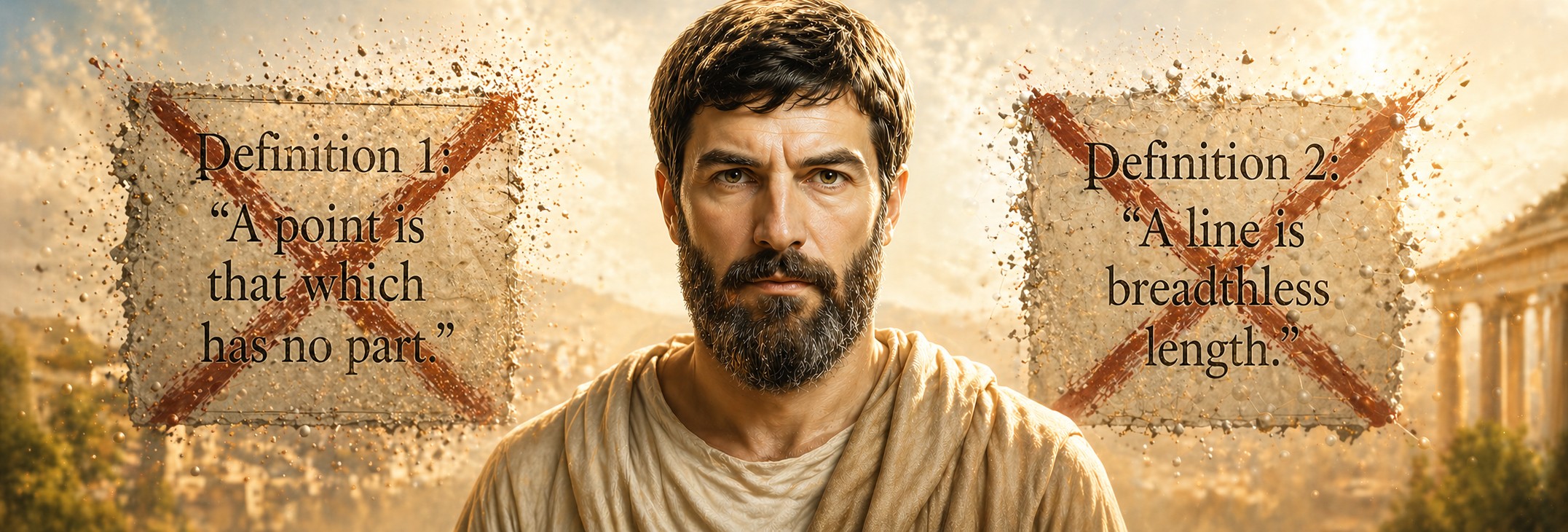
Apply this standard to the foundational objects of Euclidean geometry. Can you perceive a point? Not a dot marked on a page — that is a physical mark with definite extension. Can you perceive the geometric point the dot represents: an entity of zero dimensions, zero size, zero extension in any direction? No. By its own definition, a geometric point is not something that can present itself to perception, because it occupies no space and therefore cannot emit any image or impression that could travel to a perceiving organism. The same applies to a line of zero width, a plane of zero thickness, and the entire apparatus of classical geometry built on these foundational abstractions.
This is not a superficial objection from someone who has not understood geometry. It is the objection of someone who has understood exactly what geometry is doing and is asking whether what it is doing constitutes knowledge of physical reality or the careful development of a useful model. The Epicurean answer is that it is the latter, and that calling it the former is a specific philosophical error with specific practical consequences that Epicurus took seriously enough to make the subject of sustained analysis.
The Platonist Answer and Why Epicurus Rejected It
Section titled “The Platonist Answer and Why Epicurus Rejected It”The mathematicians had a ready response to this objection, and the Platonic tradition had provided that response with its most authoritative philosophical housing: mathematical objects are not physical things, and their truth does not depend on being perceivable. The geometric point is not a physical dot; it is an eternal abstract object that the mind grasps by reason. The truths of geometry are truths about these eternal objects, and they are more certain than any truth about the physical world precisely because they are not contaminated by the changeability and imprecision that characterize everything physical. The geometer who proves that the angles of a triangle sum to two right angles has discovered something necessarily and eternally true, independent of any particular triangle drawn on any particular surface. That is supposed to establish the superiority of mathematical knowledge over perceptual knowledge, not merely its difference.
This is a coherent position, and it has been held by serious philosophers from Plato’s time to the present. But it is precisely the position that Epicurus’s entire philosophy is constructed to deny. The Platonic claim that there is a realm of abstract objects — Forms, mathematical entities, eternal truths — that is more real than the physical world is, from the Epicurean perspective, the foundational error of the Greek philosophical tradition: the invention of a “true world” behind the apparent world, a world that turns out to be the only genuine one while the world of actual experience is demoted to the status of a shadow, an approximation, an imperfect copy of something we cannot directly access.
Epicurus recognized this move for what it was. The “eternal Forms” do not explain the physical world; they duplicate it in an unobservable register and then claim that the unobservable version is the real one. Once you accept that the genuine objects of knowledge are things that cannot be perceived — that the really real is by definition inaccessible to sensation — you have abandoned the only reliable criterion of truth and opened the door to any claim whatever that is dressed in the appropriate logical garments. Plato’s Forms, the Stoic logos, the theologian’s divine creator, the physicist’s ten-dimensional manifold: these are variations on the same move. The canonical criterion is designed specifically to block that move at its foundation.
David Sedley, in his analysis of Epicurean anti-reductionism, identifies this as the systematic target of the Epicurean epistemological project. Epicurus is not making an isolated point about one corner of philosophy. He is insisting that the standard for any genuine claim about reality must be answerable to experience, and that any framework that builds its foundations on entities definitionally removed from experience has committed what we might call the constitutive error of bad philosophy. Mathematical Platonism — the claim that geometric points, lines, and planes are real objects of some non-physical kind — is that error applied to mathematics.
The Specific Objection to Infinite Divisibility
Section titled “The Specific Objection to Infinite Divisibility”The most technically developed form of the Epicurean objection concerns not just the existence of abstract geometric entities but the principle of infinite divisibility that underlies the classical treatment of continuous quantity.
Greek geometry, and the mathematical analysis of motion and magnitude that derived from it, was built on the assumption that any line segment, any magnitude, any interval of space or time can always be divided further — that there is no smallest unit, no floor beneath which division cannot proceed. This is what makes possible the method of exhaustion, the ancient precursor to integral calculus, by which areas and volumes were calculated to arbitrary precision. It is also what makes Zeno’s paradoxes seem threatening: if any distance can always be divided into further sub-distances, how does motion across any interval remain possible?
Epicurus’s response was not to offer a mathematical answer within the framework of infinite divisibility. It was to argue that the framework does not match the physical world. In the Letter to Herodotus, he introduces what modern scholars have called the doctrine of “minimal parts” (elachista):
“And since these bodies are of finite size, we must not think that they can be divided without limit. For if this were so, what is now finite would be divided into an infinite quantity of parts, and we should have things made up of nothing; for how could things composed of parts that are, as it were, non-existent be just as real as those parts are? And the minimum perceptible is neither as small as what admits of transitions from point to point, nor completely identical with such a transition, but has something in common with it; yet while it does not admit of differentiation into parts, it does admit of measurement, larger by more of them, smaller by fewer.” — Epicurus, Letter to Herodotus 56—57
The argument is clear in its structure. If matter were infinitely divisible, you would ultimately reach parts that are themselves nothing — zero-dimensional, zero-extension entities. A composite of nothings is nothing. The world we observe is not nothing. Therefore, matter is not infinitely divisible. Therefore, there must be a minimum unit of extension below which division cannot proceed.
This minimum unit is not the atom, which is the fundamental indivisible unit of matter. It is the minimum part (elachiston): the smallest meaningful chunk of spatial extension as such. Atoms in Epicurean physics are themselves extended objects composed of minimum parts. It is these minimum parts that establish the smallest possible structural unit of any extended thing and that constitute the Epicurean answer to the geometer’s infinite divisibility.
A Methodological Note: Guardrails, Not Final Answers
Section titled “A Methodological Note: Guardrails, Not Final Answers”Before proceeding to the detailed analysis of what the minimum part doctrine involves, one point of method deserves to be stated plainly. It connects directly to the approach developed in the companion article on Epicurean physics, and it governs the argument throughout this article as well.
The canonical standard as Epicurus applies it is primarily an eliminative tool. Its first function is to identify what cannot be the case — to rule out accounts of physical reality that contradict what sensation and experience establish. A.A. Long, in his analysis of Epicurean natural philosophy, identified this dual character precisely: Epicurus operates at the level of necessary foundational propositions — what must be true and what cannot be true given what we observe — and separately at the level of specific explanatory hypotheses about particular mechanisms, which remain tentative and revisable. The foundational propositions function as guardrails. At the level of specific mechanisms, Epicurus explicitly endorsed holding multiple possible explanations rather than committing dogmatically to one where the evidence does not definitively settle the question.
The practical significance of this distinction is important. This article argues with confidence that the foundational objects of Euclidean geometry — dimensionless points, breadthless lines, infinitely divisible continua — are not physical constituents of space. That is the guardrail, and it follows from the canonical principle with the same logical directness that “nothing comes from nothing” follows from the principle of conservation: it eliminates a specific class of answers about what reality’s ultimate structure can be. What the article does not argue — and what Epicurus himself carefully did not do — is that this eliminative conclusion also settles which specific positive theory of discrete spatial structure is correct. Among all theories that satisfy the canonical standard — that posit granular, physically real structure consistent with what observation establishes — we do not arbitrarily select one. The investigation of competing candidates proceeds rationally, without premature closure, and with all consistent hypotheses held open as legitimate subjects of continued inquiry.
The relevance of this point will become clear when we examine modern physics. The Epicurean framework rules out with confidence that space is infinitely divisible in the Euclidean sense. It does not rule in any single specific discrete theory above its competitors. As the companion physics article showed in the context of Le Sage’s gravitational corpuscle theory, the Epicurean verdict on a hypothesis that is consistent with the foundational principles but not yet confirmed in its specific details is not dismissal and not acceptance, but continued serious investigation. That is the posture this article recommends for the several competing discrete-spacetime theories currently under investigation in physics. The guardrails are established. The specific mechanism remains an open question, and it should be treated as one.
Part Two: The Doctrine of Minima — Sedley, Furley, and Konstan
Section titled “Part Two: The Doctrine of Minima — Sedley, Furley, and Konstan”Physical Indivisibility versus Conceptual Divisibility
Section titled “Physical Indivisibility versus Conceptual Divisibility”The scholarly analysis of Epicurean minima has been developed primarily by David Sedley, David Furley, David Konstan, and Gregory Vlastos, and together their work has done more than any other body of modern scholarship to clarify what Epicurus was and was not claiming.
The key distinction Sedley draws is between physical indivisibility and conceptual divisibility. The minimum part is not something that cannot be thought of as having two halves — in abstract reasoning, we can distinguish between the left side and the right side of a minimum part. It is something that cannot exist in a divided state in the physical world. The distinction is subtle but important: Epicurus is not denying that our minds can perform mathematical operations on arbitrarily small quantities. He is denying that these mental operations correspond to physical processes that could actually occur. The conceptual division of a minimum part is a movement of the mind through an abstract space; it does not describe anything that matter can actually do.
This distinction is what gives the doctrine of minima its epistemological force against abstract mathematics. The geometer says: I can always bisect any line segment; therefore there is no minimum length; therefore space is continuous and infinitely divisible. Epicurus replies: your ability to bisect a line segment in abstract thought does not establish that a physical line segment can always be physically bisected. The operation is one your mind performs on a representation of the world; it is not a report of what the world itself permits. And the world, as the argument for minima establishes, does not permit division without limit.
Furley, in Two Studies in the Greek Atomists, traces the ancient debate about indivisible magnitudes back through Aristotle, showing how Epicurus’s position represents a deliberate and careful response to Aristotle’s analysis of minima in motion. Aristotle had argued that if there are indivisible magnitudes, then the units of space, time, and motion must all be correspondingly indivisible and equal — otherwise contradictions follow in the description of moving bodies. Furley shows that Epicurus accepted this consequence and developed a theory of discontinuous, quantum motion to accommodate it: one unit of motion involves traversing one unit of space in one unit of time, and at any given moment it is correct to say not “the atom is moving” but only “the atom has moved.”
Vlastos, in his complementary study of minimal parts specifically, examines how Epicurus’s minimum parts function as units of measure (katametremata) — not points in the geometric sense (which have no extension) but extended units from which spatial magnitudes are built up by integer multiples, analogously to the way the number system is built from discrete counting units.
The Contact Problem: Konstan’s Extension
Section titled “The Contact Problem: Konstan’s Extension”Konstan’s “Problems in Epicurean Physics” extends the analysis in a direction that is directly relevant to the anti-geometry argument, though Konstan approaches it from the side of atomic physics rather than epistemology. His central question in Section II is: how do atoms maintain distinct identities when in contact with each other?
The problem is this. If the boundaries of atoms are, in the geometric sense, zero-dimensional — if the surface of an atom has no thickness, no extension, no physical reality in its own right — then when two atoms are in contact, there is no physical basis for distinguishing the boundary of one from the boundary of the other. Two adjacent atoms become, at the geometrical limit, indistinguishable from a single merged atom. Void is what separates atoms, and at the point of contact there is no void. A purely geometrical account of atomic surfaces therefore cannot explain how atoms in contact retain their individual identities and can subsequently separate.
Konstan argues that this is precisely why Epicurus endowed minimum parts with finite extension in all three dimensions. The minimum part is not a boundary in the geometric sense — a surface of zero thickness — but a physical unit with actual, if tiny, extension. This means that atomic surfaces have physical depth rather than geometric thinness, and that the contact between two atoms is a contact between genuinely extended physical units rather than between mathematical abstractions. The atoms remain distinguishable because their surfaces are themselves physical, not geometric.
This is Konstan’s conclusion in his own words: “With the Aristotelian concept of boundary, made physical by endowing it with actual if minimal extension in all dimensions, Epicurus drew the line that divided contiguous substance.” The contrast with geometry is explicit. A geometric boundary is zero-dimensional; an Epicurean minimum-part boundary is physically real precisely because it is not zero-dimensional. Without the minimum part doctrine, the atom differs from void only as its geometric complement — and two adjacent atoms cannot be physically distinguished from one. The rejection of the zero-dimensional geometric boundary is not a failure of mathematical sophistication. It is required by the physical theory.
Konstan also clarifies an important distinction between the role of minimum parts and the role of atomic solidity in Epicurean physics. Solidity — the absence of internal void — establishes that matter cannot dissolve into nothing and provides the basis for atomic permanence. The doctrine of minimum parts, by contrast, addresses the discontinuous nature of space, time, and motion, and the problem of atomic contact and boundary. These are two separate lines of reasoning with two separate targets, and Epicurus carefully maintained the distinction between them — a precision that some ancient and modern critics of the theory have missed.
The Conceptual Distinction and Its Importance
Section titled “The Conceptual Distinction and Its Importance”Sedley further argues that Epicurus understood the minimum part not merely as a concession forced on him by the threat of infinite regress, but as a positive doctrine with rich implications for how we should understand the relationship between mathematical description and physical reality.
The minimum part establishes that physical space is granular rather than continuous. It has a structure, a finest level of resolution below which the concept of extension does not apply. Mathematical geometry, by assuming that space is infinitely divisible and continuous, is building on a foundation that does not match the actual structure of physical space. It is extraordinarily useful for calculation. It is not a description of what physical space ultimately is.
This is the core of the Epicurean position, and it is stated without hostility to mathematics as a practical discipline. The geometer’s results are reliable within the domain where the infinite-divisibility idealization holds — that is, at scales far above the minimum, where large aggregates of minimum parts behave, to excellent approximation, as a smooth continuum. The geometer’s results become misleading only when they are taken as descriptions of ultimate physical reality rather than as properties of a useful formal model. It is the ontological claim — the claim that the smooth continuum is what space actually is at its deepest level — that the Epicurean canonical standard disallows.
Part Three: The Ancient Debate — Geometry in the Epicurean Crosshairs
Section titled “Part Three: The Ancient Debate — Geometry in the Epicurean Crosshairs”Polyaenus and the Significance of His Position
Section titled “Polyaenus and the Significance of His Position”The episode of Polyaenus of Lampsacus is the most direct historical evidence we have of Epicurean engagement with professional mathematics. Polyaenus had been a skilled mathematician before coming to Epicurus; after becoming an Epicurean, he declared geometry to be false. Ancient sources — primarily Proclus, the fifth-century Neoplatonist commentator on Euclid — treated this as a cautionary tale about what Epicureanism did to otherwise capable minds.
The dismissal should be set aside. Sedley’s analysis in “Epicurus and the Mathematicians of Cyzicus” provides the most sustained modern examination of this episode and shows that the Epicurean challenge to geometry was not a blanket rejection of quantitative reasoning but a targeted objection to the ontological claims that Euclidean geometry implicitly makes. The mathematicians of Cyzicus — a school associated with astronomical and geometrical work in the Hellenistic period — would have understood the Epicurean challenge as precisely what it was: a serious philosophical objection to the status of their discipline’s foundational objects. If geometric points and lines are not real things of any kind, then the entire deductive structure of Euclidean geometry, however internally valid, is a system of inferences about nothing. The question of what geometric objects are is not peripheral to mathematics. It is the question that determines whether mathematics is knowledge of reality or an elaborate formal game.
When Polyaenus said geometry is “false,” he was almost certainly not claiming that the Pythagorean theorem fails when carpenters use it to square a right angle. He was claiming that the theoretical objects about which the Pythagorean theorem is strictly speaking stated — dimensionless points, breadthless lines, angles in the Euclidean sense — do not exist in the physical world, and that a theorem about non-existent objects cannot constitute knowledge of physical reality in the canonical sense. The theorem is valid as internal reasoning within the geometric system. It is false as a claim about the ultimate structure of space.
Demetrius Lacon and the Later Epicurean Engagement
Section titled “Demetrius Lacon and the Later Epicurean Engagement”The Epicurean school did not simply assert its rejection of geometry and move on. Later Epicureans engaged the mathematical tradition in detail. Demetrius Lacon, a philosopher of the second and first centuries BC whose works survive in fragmentary form among the Herculaneum papyri, wrote on geometry, music theory, and rhetoric — disciplines the Epicureans did not dismiss but analyzed from within their own philosophical framework.
The fragments of Demetrius’s work on geometry suggest that his approach was to account for what geometry actually does — how it produces reliable practical results — without conceding that it does so because its foundational objects are real. The picture that emerges treats geometry as a highly refined system of idealized approximation: it works because real physical objects approximate the behavior of the ideal objects closely enough for practical purposes, not because the ideal objects are themselves constituents of reality. This is a more considered position than blunt rejection. It permits the Epicurean to acknowledge geometry’s enormous practical utility while maintaining that its foundations are models rather than mirrors of physical fact.
The Pattern the Epicureans Were Identifying
Section titled “The Pattern the Epicureans Were Identifying”It is worth being precise about what the Epicurean critique was and was not. It was not a claim that mathematics is useless. It was not a claim that geometry’s results are practically unreliable. It was not a claim that quantitative reasoning has no place in natural philosophy. Epicurus himself made careful use of mathematical reasoning in developing the doctrine of minima, and the Epicurean tradition continued to engage seriously with quantitative science throughout its history.
The claim was precisely this: that when the formal properties of a mathematical system are taken to describe the ultimate structure of physical reality, something has gone wrong. The mathematical system may be internally consistent and practically powerful. Those properties do not, by themselves, establish that the system’s foundational objects exist in the physical world. To make that inference requires independent evidence from sensation and experience — and for the foundational objects of Euclidean geometry, such evidence is not available, because by definition those objects have no properties that sensation could register.
Part Four: A Materialist Alternative — What Epicurean Mathematics Would Look Like
Section titled “Part Four: A Materialist Alternative — What Epicurean Mathematics Would Look Like”The Arithmetic of Minima
Section titled “The Arithmetic of Minima”The Epicurean framework does not leave a mathematical vacuum in place of the geometry it critiques. The doctrine of minima provides the basis for an alternative approach to spatial magnitude — one that would look different from Euclidean geometry but would be genuinely mathematical in the sense of providing systematic, quantitative reasoning about spatial relationships.
In this alternative framework, the fundamental unit of spatial measurement is not the abstract geometric point (dimensionless) or any arbitrarily chosen unit length (infinitely divisible), but the minimum part: the smallest actually existing chunk of spatial extension. All spatial quantities are then integer multiples of this minimum. “Length” becomes a count. “Area” becomes a product of counts. Division is not infinitely iterable — you cannot keep dividing until you reach a quantity smaller than the minimum — and the concept of an irrational number, in the full Euclidean sense, requires reinterpretation at the scale of fundamental physics.
The ancient Epicurean writers seem to have been at least partly aware that their doctrine implied this arithmetic structure. The comparison they drew between the minimum part and the unit in arithmetic is suggestive: just as the number system is built on discrete units (you cannot have half of one counting unit without changing the unit), spatial magnitude is built on discrete minimum parts. The continuity that Euclidean geometry assumes is, on this view, a property that large collections of minimum parts appear to have when viewed at scales far above the minimum, just as a beach appears continuous from a distance even though it is composed of discrete grains.
Michael White, in The Continuous and the Discrete, examines this Epicurean position with analytical care, tracing the philosophical implications of the minimum part doctrine for the treatment of motion, rest, and spatial continuity. White shows that the Epicurean framework is not merely a negative critique of geometric continuity but an attempt at a positive alternative theory of spatial structure — one that faces genuine mathematical challenges but also has genuine advantages, above all the avoidance of the paradoxes that attend actual infinity and infinite divisibility.
The Problem of the Diagonal
Section titled “The Problem of the Diagonal”The most immediate mathematical difficulty for an Epicurean geometry of discrete minima is the problem of incommensurability — the discovery, associated in ancient tradition with the Pythagorean school, that the diagonal of a square and its side are incommensurable: no unit, however small, can measure both exactly. From the Euclidean perspective, this means that space cannot be merely discrete; there are lengths that fall between any two integer multiples of any unit, no matter how fine.
The Epicurean response to this is not to deny the mathematical result but to reinterpret its significance. If space is genuinely discrete, then the diagonal of a minimum-sized square is not a determinate length in the strict geometric sense. We can approximate it as closely as we like by taking counts of minimum parts in appropriate directions, but we cannot define it as an exact ratio of minimum parts in the way that Euclidean geometry defines it as an exact ratio. The geometrical diagonal, in the Epicurean framework, is another idealization — reliable for practical calculation, not a description of something that physically exists with precise Euclidean properties.
This may seem like a concession. It is worth noting, then, that something very like this concession was eventually forced on physics by the discoveries of the twentieth century. As we shall see, modern physics has established that the concept of a length shorter than the Planck scale is physically meaningless — not merely unmeasurable but devoid of physical content. The incommensurability that seemed to defeat the Epicurean program for discrete geometry turns out, when physics is pushed to its physical limits, to be a mathematical artifact that does not describe anything physically real at the smallest scales.
Part Five: Anticipations and Vindications — From Berkeley to the Planck Scale
Section titled “Part Five: Anticipations and Vindications — From Berkeley to the Planck Scale”Bishop Berkeley and the “Ghosts of Departed Quantities”
Section titled “Bishop Berkeley and the “Ghosts of Departed Quantities””The full philosophical elaboration of the Epicurean objection to abstract mathematical entities had to wait almost two thousand years. It came in 1734, when George Berkeley, Bishop of Cloyne, published The Analyst: A Discourse Addressed to an Infidel Mathematician. Berkeley’s target was Newton’s method of fluxions — the differential calculus — and specifically the foundational concept it relied on: the “infinitesimal,” an infinitely small but nonzero quantity whose existence Newton needed to define the derivative.
Berkeley’s objection was precise. Newton’s method required treating the infinitesimal quantity as nonzero at one stage of the calculation (when dividing by it) and as zero at another stage (when discarding it). This is contradictory: the same quantity cannot be both nonzero and zero in the same calculation. The infinitesimal, Berkeley argued, was a mathematical fiction dressed in the language of a limiting process, and the results obtained by operating on it were not strictly proven — they were correct in practice because the errors introduced by treating a nonzero quantity as zero happened to cancel out in the specific applications Newton and his followers considered.
Berkeley’s famous phrase for these infinitesimals — “ghosts of departed quantities” — captures exactly the Epicurean canonical objection applied to the mathematical entities of seventeenth-century analysis. An infinitesimal is not something you can perceive. It is not something that corresponds to any physical quantity, since no physical measuring instrument can register a quantity smaller than some finite threshold. It is an entity invented to make a calculation work, given a kind of nominal existence by being named, and then used as though it were a genuine mathematical object. Berkeley was not arguing that the results of the calculus were wrong in practice. He was arguing that they had not been properly demonstrated, because the proof procedures relied on an entity whose status was, in the canonical sense, illegitimate.
This is the Epicurean objection in its most technically precise form. Berkeley was pressing in the domain of seventeenth-century analysis exactly the argument Polyaenus had pressed in the domain of fourth-century BC geometry. The canonical criterion demands that mathematical objects, if they are to constitute genuine knowledge of physical reality, must be answerable to something in experience. Infinitesimals are not. Geometric points are not. Lines of zero width are not. Whatever work these entities do in generating useful results, they cannot be granted the status of genuine constituents of physical reality.
The Foundations Crisis
Section titled “The Foundations Crisis”Berkeley’s critique was taken seriously in ways the Epicurean version had not been, precisely because it targeted the most prestigious scientific achievement of his era — the mathematical engine of Newton’s Principia, the foundation of classical mechanics. His attack was not effectively answered for more than a century.
When the answer came, it was Augustin-Louis Cauchy and then Karl Weierstrass who provided it, replacing Newton’s infinitesimals with the epsilon-delta framework: instead of talking about infinitely small quantities, one talks about “for any positive epsilon, however small, there exists a delta…” This eliminated the ghostly infinitesimal from the formal language of analysis and replaced it with a framework in which all quantities remain finite. Berkeley’s technical objection was answered.
But the underlying philosophical question was not. The epsilon-delta framework changed the mathematical language while leaving intact the foundational assumption that the real numbers — the infinitely fine continuum of Euclidean geometry — provide the correct framework for describing physical space and time. Whether real-number mathematics describes physical reality, or whether physical reality is discrete in the way Epicurus’s minimum parts imply, was not addressed by making the formal language of analysis more rigorous. That question required physics to answer it, and the answer physics gave in the twentieth century was on Epicurus’s side.
The Planck Length and the Discreteness of Physical Space
Section titled “The Planck Length and the Discreteness of Physical Space”Quantum mechanics establishes that physical quantities come in discrete units below which the concept of “a smaller amount” loses physical meaning. Energy is not infinitely divisible; it comes in quanta. This discreteness is not a feature of measuring instruments but a feature of nature itself.
General relativity establishes that space and time are not a fixed geometrical background but a dynamic physical entity that curves in the presence of mass-energy. Combining these two theories — the project of quantum gravity — leads to the concept of the Planck scale: a set of natural units defined by the gravitational constant, the speed of light, and Planck’s constant, that sets the scale at which quantum-gravitational effects become decisive.
The Planck length — approximately 1.616 × 10⁻³⁵ meters — is not merely the smallest length we can currently measure. According to the best current understanding of quantum gravity, it is the smallest length that is physically meaningful. Below the Planck scale, the concept of spatial distance breaks down. Space and time no longer behave as a smooth continuum; quantum fluctuations at that scale are violent enough to make classical spacetime geometry inapplicable. What replaces it is not yet fully understood, but the leading candidate frameworks — loop quantum gravity, spin-foam models, and several approaches in string theory — agree that the structure of spacetime below the Planck scale is discrete rather than continuous.
The Epicurean minimum part is not numerically identical to the Planck length — Epicurus was reasoning from philosophical principles, not from physical measurement, and could not have calculated a specific value. But the conceptual identification is precise. Both are minimum units of spatial extension: not the smallest things we have so far measured, but the smallest things that physical analysis permits to have physical meaning. Both imply that the infinite divisibility assumed by Euclidean geometry is a mathematical idealization that does not match the actual structure of physical space. Both imply that the real-number continuum, while a useful approximation at human-scale distances, is not the correct description of what space fundamentally is.
Loop Quantum Gravity and the Geometry of Discreteness
Section titled “Loop Quantum Gravity and the Geometry of Discreteness”The implications of this physical picture for the status of abstract mathematics are precisely what Epicurus would have predicted. In loop quantum gravity, space is built from finite, discrete quanta of spatial volume that cannot be subdivided. The smooth Riemannian geometry of general relativity emerges as an approximation when large numbers of these discrete quanta are considered together — just as a smooth beach emerges from a large collection of discrete grains. At the fundamental level, the geometry of space is not a continuous manifold but a combinatorial structure of discrete, countable elements.
The mathematics used to describe this discrete structure is not Euclidean geometry. It is graph theory, combinatorics, and quantum algebra. The Euclidean concepts of point, line, and plane do not appear at the fundamental level of these theories; they appear only at the approximate, emergent level of classical spacetime. Classical Euclidean geometry, for all its mathematical beauty and practical precision, describes an emergent approximation rather than fundamental physical reality. The ancient geometer who insisted that the real structure of space is continuous and infinitely divisible was asserting something that turns out, in light of modern physics, to be an excellent practical approximation and a fundamental misrepresentation. The Epicurean who insisted that space must have a minimum unit was pointing, from philosophical principle and without the benefit of physical measurement, in the direction that physics has eventually moved.
Part Six: The Broader Significance — Mathematics as Model, Not Mirror
Section titled “Part Six: The Broader Significance — Mathematics as Model, Not Mirror”The Pattern of Error That Epicurus Was Identifying
Section titled “The Pattern of Error That Epicurus Was Identifying”What Epicurus was identifying in the mathematical tradition is an instance of a pattern he identified throughout ancient philosophy: the confusion of a useful model with the reality it models. The model is constructed by abstraction — by deliberately ignoring features of real things in order to reason more cleanly about selected relationships. A geometric circle ignores the physical material of which a real wheel is made, ignores its slight imperfections, ignores its extension in depth as well as across a plane. By ignoring all of these, it allows reasoning about shape in general, and that reasoning produces results that can be applied to real wheels with great accuracy.
The error comes when the model is mistaken for reality — when the geometer concludes that because the abstract circle has been so useful, there must be genuine abstract circles somewhere, and that these abstract circles are the real circles of which physical wheels are merely imperfect copies. This is the Platonic move, and it is the move that the canonical standard forbids. The abstract circle is not an object; it is a tool of reasoning. It is useful because real wheels are approximately circular. It is not a constituent of reality because nothing in the physical world can actually be the zero-width, zero-depth figure that the abstraction requires.
The same pattern plays out with geometric points. The point is a useful tool: it allows reasoning about location and position without the complication of size and shape. Results derived using points are useful because real objects have positions approximately like the points that represent them. But no object actually has zero size. The point is a model, not a mirror.
This distinction — model versus mirror — is one that modern philosophy of science has taken seriously in ways that ancient philosophy largely did not, and it vindicates the Epicurean position at a general level quite apart from the specific physical question of the Planck length. The instrumentalist tradition in philosophy of science holds that scientific theories are tools for making predictions rather than pictures of ultimate reality. The structural realist tradition holds that science captures the relational structure of reality but not its intrinsic nature. Neither tradition would say, without substantial qualification, that the mathematical models of physics are literal descriptions of what physical things are. The Epicurean position is an ancient precedent for this clearer understanding of the relationship between formal models and physical reality — a precedent that went largely unrecognized for two millennia.
The Guardrail Epicurus Was Providing
Section titled “The Guardrail Epicurus Was Providing”The companion article on Epicurean physics argued that Epicurus’s physical doctrines function as guardrails against specific kinds of error that have repeatedly distorted human understanding. The same framing applies here. The canonical criterion applied to mathematical entities is a guardrail against the specific error of confusing formal models with physical reality — the error of taking the conceptual tools through which we reason about the world for the furniture of the world itself.
This error has practical consequences. When the mathematical formalism of Newtonian physics — built on the infinite real-number continuum and the Euclidean geometry of absolute space — was taken as a literal description of what space is, it set constraints on physical thinking that took two centuries to escape. Space must be continuous; time must flow uniformly; positions must be exactly localizable — because the mathematics said so, and the mathematics was identified with reality. Einstein’s general relativity and the quantum revolution required, among other things, a loosening of the grip that classical mathematical formalisms had on physical imagination. Space turned out not to be Euclidean; time turned out not to flow uniformly; position turned out not to be exactly localizable. The mathematics had been an excellent model. It had not been a mirror.
Epicurus’s canonical guardrail — insist that your foundational objects be answerable to sensation and experience; be suspicious of any framework built on entities definitionally removed from the observable world — would not have told Hellenistic astronomers the specific values of the Planck length or the equations of quantum mechanics. But it would have preserved, as a standing philosophical commitment, the openness to the discovery that the real structure of space might be something quite different from the smooth Euclidean continuum that the mathematical tradition had placed at the foundation of its account of reality.
Part Seven: The Connection to Adulteration, and the Urgency of the Issue Today
Section titled “Part Seven: The Connection to Adulteration, and the Urgency of the Issue Today”Not Anti-Science but Anti-Overreach
Section titled “Not Anti-Science but Anti-Overreach”The Epicurean rejection of abstract mathematical Platonism is sometimes misread as anti-scientific or as a symptom of alleged Epicurean hostility to advanced technical learning. This misreading should be firmly put aside. Epicurus was not arguing against mathematical calculation, against quantitative reasoning, or against the use of geometry for practical and scientific purposes. The Epicurean tradition included mathematicians, engaged with astronomical work, and continued to take quantitative science seriously throughout its history.
What Epicurus was arguing against was a specific philosophical claim: that the abstract objects of mathematical geometry — entities defined precisely by their lack of any physical property that sensation could register — are genuine features of reality rather than useful idealizations. This is not anti-science. It is the application of the canonical standard to the domain of mathematical ontology. And it is a position that a large and growing number of scientists and philosophers of science would, if pressed, find themselves agreeing with: the mathematical formalisms of physics are models, extraordinarily powerful and accurate models, but models nonetheless.
The Connection to the Three Adulterations
Section titled “The Connection to the Three Adulterations”There is a deeper connection between the Epicurean rejection of mathematical Platonism and the broader theme of philosophical adulteration that runs through Epicurean history. The three primary adulterations of Epicurean philosophy — Platonism, Stoicism, and supernatural religion — all share a common structure. Each posits a “true world” behind or above the world of experience: Plato’s Forms and mathematical objects, the Stoic logos and cosmic reason, the theologian’s god and divine providence. Each then argues that the true world is more real, more valuable, and more authoritative than the world we actually inhabit. And from this move each derives the characteristic conclusions that Epicurus identified as sources of unnecessary human suffering: that pleasure is not the standard of good, that death is to be feared, and that our own experience and judgment are not to be trusted.
The Platonic account of mathematical objects is not a peripheral element of this pattern. It is one of its most intellectually seductive expressions. When the geometer tells you that the geometric circle — dimensionless, perfect, eternal — is more real than any physical wheel you can make or measure, and that the physical wheel is valuable only insofar as it approximates the eternal Form, you are being invited to devalue the physical world and the experience of it in favor of an abstract realm that only reason can access. This is the Platonic move in a mathematical key, and it is no less dangerous for being expressed in the politically neutral language of geometry rather than the obviously theological language of divine creation.
Why the Issue Is More Urgent Today Than in the Ancient World
Section titled “Why the Issue Is More Urgent Today Than in the Ancient World”When Epicurus established the canonical standard as a guardrail against mathematical overreach, the relevant overreach was the Platonic elevation of geometric abstractions into eternal realities. That was a serious error with serious consequences, and it deserved the systematic philosophical response Epicurus gave it.
The situation today is more extreme. The mathematical abstraction that Epicurus was resisting — a smooth, infinitely divisible geometric continuum — was at least a generalization from something observable. The forms of mathematical overreach that are now widespread in theoretical physics go considerably further. When a physical theory requires entities that are not merely unobserved but unobservable in principle — parallel universes that can never interact with our own, spatial dimensions that are permanently curled beyond any possible detection, mathematical structures that are said to constitute physical reality itself — the departure from the canonical standard is not a matter of degree but of kind. These are not even approximations to something sensory. They are purely formal entities granted physical existence by virtue of appearing in equations.
This is precisely the kind of move that Epicurus was equipping his students to recognize and resist. The question “does this entity actually exist in the physical world, or does it merely exist in my formal system?” is not a question that physics can answer from within its own formal framework. It is a philosophical question, and it requires the kind of epistemological clarity that Epicurus was developing when he established the canonical criterion as the standard for all claims about what exists.
Konstan concludes his analysis of Epicurean atomic mechanics by noting that Epicurus’s theory “represents a major achievement in the history of mechanistic world models” and that “it is yet to claim its rightful place in the history of science.” That observation, made in 1979 specifically about Epicurean physics, applies with equal force to Epicurus’s epistemological framework for evaluating mathematical claims about reality. That framework is not yet fully appreciated. But its moment of relevance — if it had one to miss — is now, when the inflation of mathematical formalism into metaphysical reality has reached a scale that makes the debates in Plato’s Academy look comparatively modest.
Conclusion: The Inscription Revisited
Section titled “Conclusion: The Inscription Revisited”We began with two inscriptions over two doors — one actual, one imagined. Plato’s Academy announced that you could not enter it without geometry; that the world as it truly is could only be grasped by those who had trained their minds on entities that no sensation could reach. The Epicurean Garden announced, in the terms we have been exploring throughout this article, the exact opposite: that those who allow the properties of mathematical formalisms to override the evidence of sensation have already made the decisive error, and no amount of formal sophistication will correct it from the inside.
The argument between these two inscriptions has not been settled. It is more active today than at any point since it was first posed. The question of whether mathematical elegance is evidence of physical reality — whether the requirement that equations be satisfied constitutes an independent reason for believing that the entities those equations describe actually exist — is not a peripheral question in current physics and philosophy of science. It is the central one, and it is answered very differently by different serious thinkers.
Epicurus answered it clearly, and he answered it on the right side. The canonical standard demands that claims about physical existence be answerable to experience. Mathematical consistency is not experience. Formal elegance is not experience. The requirement that your equations balance is not experience. These are features of models, and a model can be internally consistent and formally beautiful while failing to describe any physical reality at all. History has provided examples in both directions: models that were formally beautiful and physically accurate, and models that were formally beautiful and physically wrong. Beauty and consistency alone do not decide which category a given model falls into.
What decides it, in the end, is the test that Epicurus insisted on from the beginning: bring the claim back to what sensation and experience establish, and be honest about what that test shows. When a mathematical claim about the ultimate nature of space passes that test — when the discrete, granular structure of spacetime at the Planck scale is confirmed by physical investigation — it counts as knowledge. When a mathematical claim about the ultimate nature of reality fails that test — when it describes entities that are unobservable in principle, that exist only because the formalism requires them, that can be confirmed by no possible experience — it does not count as knowledge, however impressively it is dressed.
It is worth being clear about what this conclusion does and does not require of us, because the point matters for how the Epicurean framework applies to current physics. The canonical standard, as this article has argued from the beginning, functions primarily as a set of guardrails. It tells us with confidence what the ultimate structure of space cannot be: infinitely divisible, composed of dimensionless geometric points, correctly described by a formalism whose foundational objects have no correspondence to anything observable. Those are the things ruled out. They are ruled out because they contradict what sensation and careful physical investigation establish.
What the canonical standard does not do is require us to declare one specific discrete-spacetime theory the winner before the evidence warrants it. Among the competing frameworks that posit granular, physically real spatial structure — loop quantum gravity, causal set theory, spin-foam models, and others — each of which is consistent with what observation currently shows, the Epicurean approach holds all of them as legitimate candidates for continued investigation. We examine them rationally, we test their specific predictions against what can be observed, we eliminate those whose predictions contradict the evidence, and we do not arbitrarily pick from among those that survive. This is precisely the method the companion article on Epicurean physics identified in Epicurus’s treatment of gravity, magnetism, and the size of the sun. The refusal to commit to a specific measurement of the sun’s size, when no means of verifying such a measurement was available, meant that the Epicureans avoided being concretely wrong while every ancient astronomer who gave a specific figure was dramatically, confidently, and precisely in error. Holding multiple consistent hypotheses honestly and continuing the investigation is not evasion. It is the method Epicurus prescribed for all questions where the canonical standard has established the guardrails without yet settling which specific mechanism is correct — and the structure of space at its finest scale is exactly such a question.
Let all who would free themselves from the false claims of the geometers enter here. Seneca records that Epicurus did have a motto at the Garden gate, announcing that the highest good is pleasure. That inscription was the Garden’s declaration of what the philosophical life is actually for — the pursuit of pleasure, not the Platonic ascent toward abstract Forms. The title of this article is the Garden’s philosophical companion to that declaration: a statement of what needed to be cleared away before genuine understanding of the physical world could begin. The false claims of the geometers — that the dimensionless point, the breadthless line, and the infinitely divisible continuum are more real than anything sensation can reach — were precisely what needed to be recognized as false before the Epicurean account of nature could be properly understood. Two and a half millennia later, as the inflation of mathematical abstraction into metaphysical reality reaches heights that would have surprised even Plato, both inscriptions deserve their place over the same door — the declaration of pleasure as the goal, and the identification of geometry’s false realities as an obstacle to it.
Key Sources Referenced
Section titled “Key Sources Referenced”- Epicurus, Letter to Herodotus, sections 38—44 (conservation, atoms, void) and 56—59 (minimal parts); in Bailey, Epicurus: The Extant Remains (Oxford, 1926)
- Epicurus, Principal Doctrines; Bailey translation
- David Sedley, “Epicurus and the Mathematicians of Cyzicus,” Cronache Ercolanesi 6 (1976), pp. 23—54
- David Sedley, “Epicurean Anti-Reductionism,” in J. Barnes and M. Mignucci (eds.), Matter and Metaphysics (Naples: Bibliopolis, 1988), pp. 295—327
- A.A. Long and D.N. Sedley, The Hellenistic Philosophers, 2 vols. (Cambridge University Press, 1987); section 9 (Epicurean physics: void, atoms, minimal parts)
- David Furley, Two Studies in the Greek Atomists (Princeton University Press, 1967); Study I, “Indivisible Magnitudes”
- David Konstan, “Problems in Epicurean Physics,” Isis 70, No. 3 (1979), pp. 394—418; especially Section II on atomic contact and the physical role of minimum parts as boundaries
- Gregory Vlastos, “Minimal Parts in Epicurean Atomism,” Isis 56, No. 2 (1965), pp. 121—147
- Michael J. White, The Continuous and the Discrete: Ancient Physical Theories from a Contemporary Perspective (Oxford University Press, 1992)
- Richard Sorabji, Time, Creation and the Continuum (Cornell University Press, 1983); chapters on atomism and infinite divisibility
- George Berkeley, The Analyst: A Discourse Addressed to an Infidel Mathematician (London, 1734)
- Euclid, Elements, Book I (definitions of point, line, and plane); Heath translation
- Proclus, Commentary on the First Book of Euclid’s Elements; Morrow translation (Princeton, 1970); references to Polyaenus
- Norman DeWitt, Epicurus and His Philosophy (University of Minnesota Press, 1954)
- Carlo Rovelli, Quantum Gravity (Cambridge University Press, 2004); on loop quantum gravity and discrete spacetime
- Lee Smolin, Three Roads to Quantum Gravity (Basic Books, 2001); accessible treatment of Planck-scale discreteness
- Companion articles: “Epicurean Canonics — The World We Experience Is the Only Real World” and “The Continued Vitality of Epicurean Physics,” EpicurusToday.com.