
A Tribute to Norman DeWitt and His Epicurus and His Philosophy
If there is one book that directly inspired the EpicurusToday project — one scholar whose reading of Epicurus confirmed that the mainstream interpretation was wrong and that a better one was possible — it is Norman DeWitt, and his 1954 work Epicurus and His Philosophy, published by the University of Minnesota Press.
This page is both a recommendation and a tribute. DeWitt deserves both.
Who Was Norman DeWitt?
Section titled “Who Was Norman DeWitt?”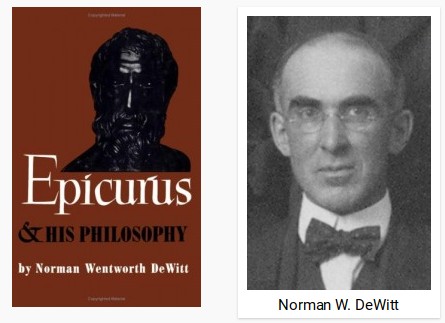
Norman Wentworth DeWitt was a professor of Latin at Victoria College, University of Toronto, who spent a career studying the ancient world and came to Epicurus late enough in his scholarly life to bring a fully formed classical education to bear on the question of what the philosophy actually said. He published Epicurus and His Philosophy in 1954, the same year as its companion volume St. Paul and Epicurus, and then largely disappeared from the bibliographies of subsequent Epicurean scholarship.
That disappearance is worth noting. DeWitt is rarely cited by modern academic commentators on Epicurus. When he is cited, it is often to register disagreement. His reading of Epicurus cuts too sharply against the grain of mainstream classical scholarship to be comfortable for those who have invested in the conventional interpretation — the one that domesticates Epicurus into a philosopher of withdrawal, minimal desire, and therapeutic calm. DeWitt will have none of that, and the academy, by and large, has not forgiven him for it.
For the purposes of EpicurusToday, however, that is precisely what makes him valuable.
What Makes the Book Extraordinary
Section titled “What Makes the Book Extraordinary”Epicurus and His Philosophy was among the first comprehensive treatments of Epicurus in modern English. That alone would make it historically significant. But what distinguishes it from everything that came before — and most of what has come after — is the ambition and coherence of its central argument.
DeWitt’s thesis is that Epicurus was not the minor, eccentric, garden-variety hedonist of popular caricature, nor the quietist philosopher of serene contentment that the modern self-help tradition has made of him. He was the founder of the first genuinely systematic philosophy of human happiness built on a materialist account of the world — a philosopher who taught his doctrines with the organizational discipline of a school, the emotional warmth of a community, and the conviction that what he had discovered was urgently needed by ordinary human beings who had been frightened into misery by false beliefs about the gods and death.
DeWitt demonstrates the fallacy of centuries of abuse of Epicurus and the resulting distortion of most discussions of Epicureanism that appear in standard philosophical works. He does this not through polemics but through sustained, detailed engagement with the Greek and Latin sources — the letters, the doctrines, the ancient testimonia — read with the eyes of a classical scholar who takes the texts seriously rather than filtering them through the accumulated prejudices of twenty-three centuries of hostile commentary.
The book is organized in a way DeWitt says Epicurus himself organized his teaching: beginning with a broad overview and then filling in the details. Epicurus thought of his writings as maps drawn to larger and smaller scales, and the process of learning was regarded as a progression from general maps with few details to regional maps with a proportionate increase in detail. DeWitt applies the same method, giving the reader the sweep of the philosophy before pressing into the specifics of physics, canonics, and ethics. The result is a book that rewards both the newcomer who wants to understand Epicurus quickly and the more experienced reader who wants the full treatment.
How DeWitt Opens: A Warning Every Reader Needs
Section titled “How DeWitt Opens: A Warning Every Reader Needs”One of the most valuable things DeWitt does — and one of the things that sets his book apart from almost every other treatment of Epicurus — is what he does in his very first chapter. Before presenting the philosophy itself, he prepares the reader for the problem they are about to encounter.
The second sentence of DeWitt’s Chapter One reads as follows:
At the very outset the reader should be prepared to think of [Epicurus] at one and the same time as the most revered and the most reviled of all founders of thought in the Graeco-Roman world.
This is not rhetorical flourish. It is an accurate description of the ancient record, and it has direct consequences for how every piece of ancient testimony about Epicurus must be read. The philosophers who hated Epicurus most bitterly — Platonists, Stoics, and later the Christian writers who absorbed their traditions — were also the philosophers who wrote the most about him. The result is that a very large proportion of the surviving ancient commentary on Epicurus comes from people who despised him, wanted to refute him, and had strong ideological reasons to misrepresent his views.
DeWitt makes clear from the outset that this is not a minor caveat to be noted and set aside. It is the central challenge facing anyone who tries to understand Epicurus from the historical record. Every time a Stoic or a Platonic or a Christian writer tells you what Epicurus believed, you are reading someone who had powerful reasons to get it wrong — and who, in many cases, demonstrably did. The tradition of representing Epicurus as a vulgar sensualist who recommended indulgence in food, drink, and sexual pleasure was built deliberately by his enemies, and it was so effective that it survived long enough to become the popular meaning of the English word epicure. The tradition of representing him as a quiet garden philosopher content with bread and water was built partly by well-meaning later followers who had absorbed Platonic and Stoic assumptions without realizing it, and partly by hostile commentators who preferred a harmless Epicurus to a challenging one.
Against both of these traditions, DeWitt insists on returning to what Epicurus himself wrote, read as carefully and as charitably as the texts of any other major philosopher. That insistence, stated plainly in the opening chapter, is the methodological foundation of everything that follows — and it is the same insistence that animates EpicurusToday. Read Epicurus himself. Read the commentators with awareness of who they were and what they had to gain from a particular interpretation. And when the hostile tradition contradicts what the primary sources actually say, follow the primary sources.
Why DeWitt Matters for EpicurusToday
Section titled “Why DeWitt Matters for EpicurusToday”The EpicurusToday project did not begin with DeWitt — it began with the texts of Epicurus and Lucretrius and grew through engagement on modern social media. But DeWitt was the scholar who confirmed, in systematic and scholarly detail, that the reading of Epicurus that felt right from the primary sources was not an eccentric personal interpretation but a defensible academic position with genuine textual support.
That matters because the mainstream interpretation of Epicurus — the one you will find in most philosophy textbooks, most academic journals, and most popular treatments — consistently underplays pleasure as the active goal of life, overemphasizes tranquility and the removal of desire as the philosophical program, and presents Epicurus as a philosopher of managed contentment rather than full engagement. DeWitt saw through this and said so, in print, with documentation.
He is not popular with mainstream commentators precisely because he is right about this, and because being right about it requires acknowledging that centuries of scholarly tradition have been systematically wrong. That is not a comfortable position for any academic tradition to accept. But it is the position the texts support, and it is the position that EpicurusToday is built on.
We cite DeWitt regularly in these pages. We recommend his book as the single best starting point for anyone who wants to understand Epicurus as he actually was rather than as he has been misrepresented. And we pay tribute to him here because he deserves recognition that the mainstream of classical scholarship has not given him.
A Note on Epicurus and Early Christianity
Section titled “A Note on Epicurus and Early Christianity”Readers who open Epicurus and His Philosophy expecting a straightforward philosophical treatise will find, particularly in certain chapters, sustained engagement with the question of the relationship between ancient Epicureanism and early Christianity. DeWitt argues — carefully and with extensive documentation — that Epicurean ideas and vocabulary were a significant influence on the language and thought of early Christian writers, including Paul. The Epicurean ethic, which allied happiness with pleasure, was so appealing and so widely acknowledged that Paul had no choice but to deal with it from the perspective of religion — adapting certain aspects while cursing others.
DeWitt pursued this line of argument so extensively that he wrote a separate companion volume — St. Paul and Epicurus, also published in 1954 — dedicated entirely to the question of Epicurean influence on the Pauline epistles.
Some readers will find this material less interesting than the core philosophical analysis. If that is your experience, you can read past those sections without losing the thread of the argument about Epicurus himself. But for many readers this dimension of the book adds rather than detracts. It is a reminder that Epicurean philosophy was not a museum piece in the ancient world but a living, influential tradition whose ideas permeated the Mediterranean world in ways that have not been fully acknowledged. For those interested in the relationship between ancient philosophy and religious tradition, DeWitt’s work opens a genuinely fascinating window.
How to Get the Book
Section titled “How to Get the Book”
Epicurus and His Philosophy is available in print through the University of Minnesota Press’s Minnesota Archive Editions series, which has kept it in print in paperback. It is also available at the Internet Archive, where the full text can be read online without charge.
There is no better single investment a student of Epicurean philosophy can make than reading this book. Start with the first three chapters to get the overview, and then follow wherever your interest takes you. You will not find a more thorough, more honest, or more intellectually courageous treatment of Epicurus anywhere in the literature.