
In The Arena: The Locations of the Garden and House of Epicurus Refute the Recluse Myth
It is not the critic who counts; not the man who points out how the strong man stumbles, or where the doer of deeds could have done them better. The credit belongs to the man who is actually in the arena, whose face is marred by dust and sweat and blood; who strives valiantly…
— Theodore Roosevelt, “Citizenship in a Republic,” Sorbonne, Paris, April 23, 1910
Introduction: A Slander With a Long Life
Section titled “Introduction: A Slander With a Long Life”Among the accusations leveled against Epicurus and his followers, few have proven more durable than the charge of reclusiveness. The Epicureans, the story goes, withdrew from civic life, refused the obligations of citizenship, and sealed themselves away from the world in a private retreat devoted to personal pleasure. The philosophical instruction to “live unknown” (lathe biosas) has been seized upon as a motto for this withdrawal. The very name “The Garden” has lent itself to the image of a walled enclosure, something private and bounded, set apart from the busy life of the city around it.
This charge is not just a modern misconception. It was being made in antiquity. Plutarch’s hostile essay Non posse suaviter vivi secundum Epicurum ridicules Epicurus’s mother for living to see her son “cooping himself up in a little garden.” Cicero, whose philosophical sympathies lay elsewhere, treated the Garden as a convenient symbol for a philosophy that had opted out of Roman public life. The slander has been repeated so often that it has acquired the texture of fact.
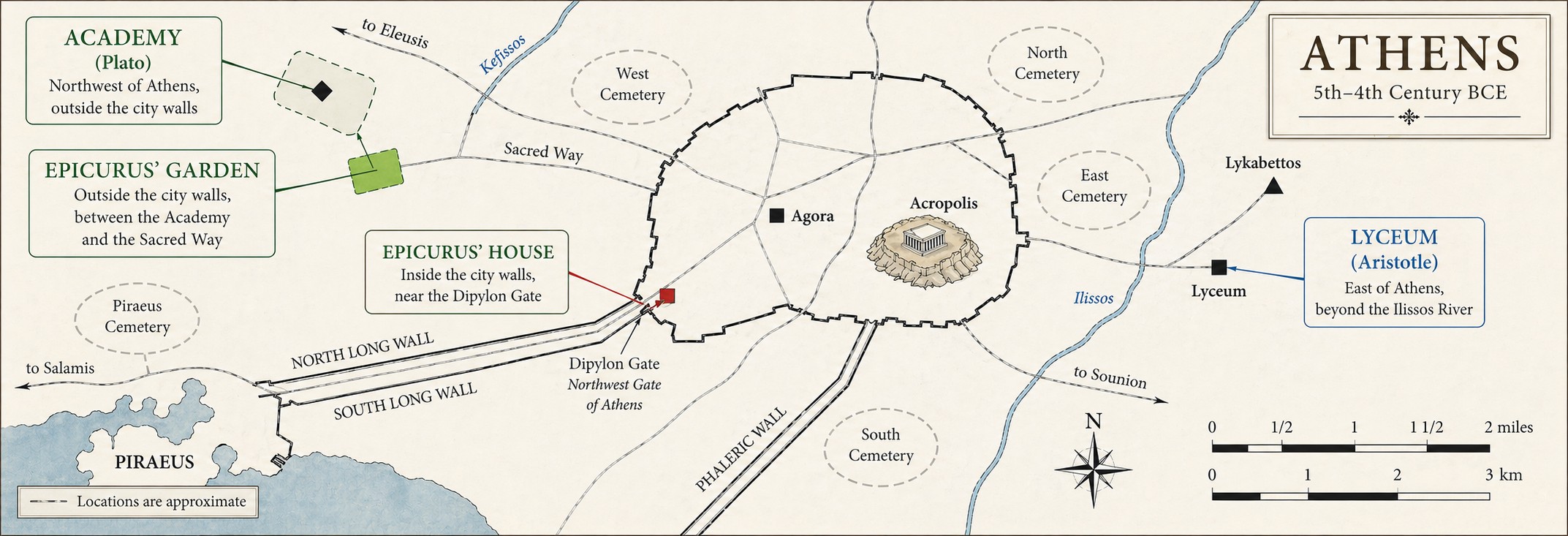
It is not a fact. It is a distortion, and one that can be tested against straightforward evidence. If the Epicureans were truly recluses who had withdrawn from Athenian society, we would expect to find their school located accordingly — far from the centers of civic activity, in some quiet suburb or rural retreat, difficult to reach and easy to ignore. What we find instead is the opposite. The Garden of Epicurus stood on the Dromos, the most celebrated ceremonial thoroughfare in Athens, on the direct route from the city’s main gate to Plato’s Academy. The house in which Epicurus himself lived was situated inside the city walls, west of the Agora, in a residential district so desirable that a prominent Roman politician sought the highest available legal authorization to build on its ruins two and a half centuries after Epicurus’s death.
Far from hiding his school, Epicurus posted a welcome sign at its gate. He was, to borrow Theodore Roosevelt’s phrase from twenty-three centuries later, a man in the arena — not a critic watching safely from the stands. This article takes its title from Roosevelt’s famous formulation precisely because the charge against Epicurus is the charge Roosevelt identified: that the philosopher had chosen the comfortable distance of the spectator over the dust and sweat of engagement. The evidence of where Epicurus actually lived and taught gives that charge the answer it deserves.
The research that makes this argument possible was assembled by Don Boozer in his paper “Where Was the Garden of Epicurus? The Evidence from the Ancient Sources and Archaeology.” Boozer’s paper works through the ancient textual record systematically, evaluates the archaeological evidence along the Dromos, and calculates what the Garden’s purchase price tells us about its likely scale. The present article takes Boozer’s findings as its foundation and develops from them a sustained argument against the recluse myth — extending his analysis with a comparative look at where the other great philosophical schools of Athens actually stood, and what that comparison reveals about the charge that has so long been laid against Epicurus.
Part One: What the Charge Actually Claims — and What It Ignores
Section titled “Part One: What the Charge Actually Claims — and What It Ignores”Before examining the evidence, it is worth being precise about what the recluse myth actually claims, because the claim tends to shift whenever the evidence pushes back against it.
In its strongest form, the charge is that Epicurus actively discouraged engagement with civic life — with politics, with education, with the public festivals and ceremonies that structured Athenian society — and that the Garden was the physical expression of this withdrawal: a community turned inward, sustained by private pleasures and philosophical conversation, indifferent to the city beyond its walls.
In a weaker form, the charge rests on little more than a comparison with the Stoics, who made a conspicuous point of locating their school in a public building in the Agora itself. By that comparison, any school with a private address could be called “reclusive.”
Neither version survives contact with the evidence. The strong form collapses when we recall that Epicurus explicitly encouraged his students to participate in the civic festivals of Athens, maintained a welcoming entrance that invited passersby to enter, drew students from across the Greek world, and built a school that attracted visits from some of the most prominent intellectual and political figures of the Hellenistic period. The weak form collapses when we notice that the same comparison that supposedly makes the Garden reclusive also makes Plato’s Academy — located even further from the city center — reclusive, as well as Aristotle’s Lyceum, which also occupied a suburban gymnasium outside the city walls. If all three of those schools escape the recluse charge, there is no principled basis for applying it to Epicurus alone.
What distinguishes the case against Epicurus is not evidence but prejudice — the desire to use his school’s location as confirmation of a philosophical caricature that was already in circulation. The actual locations of his properties tell a different story.
Part Two: The Garden on the Dromos — An Open House on Athens’s Main Road
Section titled “Part Two: The Garden on the Dromos — An Open House on Athens’s Main Road”The most important piece of evidence for the location of the Garden comes from Cicero’s De Finibus Bonorum et Malorum (5.1–3), written when the Epicurean school was still a functioning institution, active under the scholarch Phaedrus. Cicero and his companions arranged an afternoon walk from the Dipylon Gate — the great northwestern entrance to Athens — to the Academy of Plato. Cicero notes that they covered six stades from the Dipylon while conversing on various topics. Upon arriving at the Academy, Cicero’s companion Pomponius remarks that they had “just been passing” Epicurus’s Garden (quos modo praeteribamus).
This casual observation is the key. The Garden was not a destination. It was something you passed on the way to somewhere else. It was interposed between the Dipylon Gate and the Academy — on the Dromos.
The Dromos was the principal ceremonial thoroughfare of ancient Athens. It ran from the Dipylon Gate northwest through the Kerameikos district to the Academy. As Boozer notes, in some stretches it was thirty-nine meters wide. It served as the route for the great Panathenaic procession, the path of the torch race that opened the festival games, and the everyday road connecting the city to one of its most celebrated institutions. Travelers, merchants, athletes, diplomats, students, and curious visitors passed along it constantly. There was no quieter address available in Athens that was harder to ignore.
When we then recall the welcome sign that Seneca preserves for us (Epistulae Morales, Letter XXI):
Hospes hic bene manebis, hic summum bonum voluptas est. O Guest, here you will do well to tarry; here our highest good is pleasure.
— the picture that emerges is not of a sealed private community but of a school that faced the public road, posted its philosophical position at the gate, and invited every traveler who passed by to come in. Boozer points out that the Latin hospes — and its Greek equivalent xenos — carried the full weight of the ancient guest-friendship tradition: an obligation of hospitality extended to strangers as well as friends. Epicurus was not hiding his philosophy. He was advertising it on one of the busiest roads in the ancient world.
This is confirmed by the archaeological record. Working through Judith Binder’s exhaustive posthumous sourcebook The Monuments and Sites of Athens, Don Boozer identified that a statue of a seated philosopher in Epicurean style was excavated at 54 Achilleos Street, with later finds at 61 Marathonos Street including two portrait statues of Epicurus himself and two statues of enthroned philosophers — all built into a Roman wall, all datable to the second and third centuries AD. As Boozer calculates, these finds are located along the line of the ancient Dromos, approximately 871 meters from the boundary of the Academy grounds. The site corresponds precisely with where Cicero’s account would lead us to look. Five Epicurean statues in one location, two of the founder himself, placed exactly where the school’s most public road frontage would have been.
Emperor Julian, writing in the fourth century AD, still associated Epicurus with “the gardens and suburbs of Athens” (τοὺς κήπους καὶ τὸ προάστειον τῶν Ἀθηνῶν, Letter to Themistius 259b) — the suburban zone along the Dromos, the same zone Cicero’s group had walked three and a half centuries earlier. Even Heliodorus of Emesa, writing his novel Aethiopica in the third or fourth century AD, directed his characters to “the garden in which the Epicurean monument stands” as a recognizable landmark, casually assuming that any reader would know exactly where this was. Six centuries after Epicurus established the Garden, it remained a landmark on a public road that the citizens of Athens still traveled.
This is not reclusiveness. This is civic presence on the scale of an institution.
Part Three: Scale Matters — The Garden Was Not a Private Backyard
Section titled “Part Three: Scale Matters — The Garden Was Not a Private Backyard”One feature of the recluse myth is that it imagines the Garden as something small and intimate — a private enclosure just large enough to shelter a handful of philosophical friends from the world outside. The evidence of the purchase price argues against this picture.
Apollodorus the Epicurean, writing in the second century BC when he served as scholarch and was personally responsible for the property, records that Epicurus purchased the Garden for eighty minae (Diogenes Laertius 10.10–11). One mina equaled one hundred drachmas; a skilled worker in the fourth century BC earned approximately one drachma per day. Don Boozer’s paper assembles comparative property values from the fourth century BC that put this figure in its proper context: a typical Athenian house in the mid-fourth century cost approximately thirty minae; a multiple-dwelling house was valued at one hundred minae or more; farm land sold in the range of twenty to thirty minae for plots of eight to thirteen acres. Livy records that a farm of seventy acres with a house attached sold for five talents — three hundred minae — meaning the land alone was worth two hundred fifty minae at about three and a half minae per acre.
Working from these figures, Boozer conjectures that the eighty minae most likely covered both the Garden plot and the house in Melite together. If roughly fifty minae went to the Garden land at approximately three minae per acre, that purchases conservatively fifteen to seventeen acres — a plot Boozer compares in scale to the White House grounds in Washington, DC, more than large enough to grow food for a small resident community, to hold outdoor lectures under trees, and to accommodate guests from throughout the Greek world for extended stays.
This accords perfectly with what Apollodorus himself says in the same passage: “Friends indeed came to him from all parts and lived with him in his garden.” The Garden was not a retreat for a small closed circle. It was a substantial property that functioned as a school, a residence for a community, and a working farm — and it sat directly on the main road of Athens, visible and accessible to everyone.
Plutarch (Moralia 603B) notes for comparison that the Academy of Plato was purchased for three thousand drachmas — thirty minae. If Epicurus spent roughly fifty minae on the Garden land alone, his school occupied a larger plot than the Academy. The philosopher who supposedly fled civic life owned more ground than the philosopher who is never accused of reclusiveness.
Part Four: The House in Melite — Inside the City, Coveted by Rome
Section titled “Part Four: The House in Melite — Inside the City, Coveted by Rome”The Garden was the school. But Epicurus also lived somewhere, and where he lived tells us something equally important about his relationship to Athenian civic life.
Boozer draws attention to a point that is frequently overlooked: Epicurus did not own one property in Athens but two, and the Will makes the distinction explicit. The Will of Epicurus, preserved in Diogenes Laertius (10.16–17), specifies that the trustees are to permit Hermarchus and his philosophical companions to inhabit “the house in Melite” (τὴν δ᾽ οἰκίαν τὴν ἐν Μελίτῃ) for the duration of Hermarchus’s lifetime — a separate provision from the disposition of the Garden itself. Norman DeWitt, in his 1940 paper “Epicurus’ Three-Wheeled Chair,” argued that this separation was practically significant: Epicurus commuted daily between the house in Melite and the Garden where he lectured, the two properties being sufficiently distant from each other to require deliberate travel between them. The Garden was the schoolroom; the house was the residence. Melite was a recognized deme — a civic subdivision — of ancient Athens, situated immediately to the west of the Agora. John S. Traill’s authoritative Political Organization of Attica places Melite’s location with certainty from both literary sources and archaeological evidence: west of the Agora, within the city walls, in one of Athens’s established residential districts. As Boozer emphasizes, this was not a peripheral location. The Melite deme occupied urban territory at the civic core of Athens. West of the Agora placed it close to the center of Athenian political, commercial, and social life — closer, in fact, than either the Academy to the northwest or the Lyceum to the east, both of which lay outside the city walls entirely. Epicurus’s personal residence was more centrally located within Athens than the schools of either Plato or Aristotle.
The most compelling evidence that this was prime Athenian real estate comes not from Epicurus’s lifetime but from 51 BC, when the Roman Gaius Memmius — the man to whom Lucretius dedicated De Rerum Natura — attempted to build on the site. By Cicero’s time the house had fallen into ruin, almost certainly as a result of Sulla’s devastating sack of Athens in 86 BC. Cicero describes it dismissively as “Epicurus’s old ruins” (nescio quid illud Epicuri parietinarum) and “the ruins in Melite” (parietinis in Melita). But ruined or not, the site in Melite was desirable enough that Memmius had gone to considerable lengths to claim it.
As Oxford scholars Llewelyn Morgan and Barnaby Taylor established in their 2017 study “Memmius the Epicurean,” Memmius had secured a formal decree of the Areopagus — the hupomnematisnos — giving him licensed authority to build there. An Areopagus decree was the highest local judicial authorization available. A prominent Roman politician, living in Athens as an exile after the failed consular elections of 53 BC, had applied to the city’s supreme court to obtain rights over a specific piece of urban real estate. You do not go to those lengths for an out-of-the-way property.
Patro, the scholarch of the Epicurean school, mounted vigorous resistance. As Cicero summarizes Patro’s appeal to Memmius: the community was obliged to maintain “honor, duty, testamentary right, the injunction of Epicurus, the protest raised by Phaedrus, the abode, the dwelling, the footprints of illustrious men” (sedem, domicilium, vestigia summorum hominum). Even in ruins, the house in Melite was treated as a monument of civic and philosophical significance — significant enough to generate a legal dispute that required Cicero’s diplomatic intervention and, ultimately, a formal reversal of the Areopagus decree.
That dispute, spanning the correspondence of one of Rome’s most prominent orators and concerning the highest judicial body in Athens, gives us the measure of what the house in Melite represented. This was not the dwelling of a recluse. It was the founding address of a school that Athens’s civic institutions recognized, protected, and contested across two and a half centuries.
Part Five: Comparing the Schools — Who Was Actually Less Engaged?
Section titled “Part Five: Comparing the Schools — Who Was Actually Less Engaged?”If we grant, as we must, that the Garden and house of Epicurus occupied central and publicly accessible locations in and around Athens, the next question is whether this distinguishes Epicurus from his contemporaries or puts him in their company. The answer is unambiguous: it puts him in their company — and in one crucial respect, the location of his personal house, it makes him more centrally located than his principal rivals.
Plato’s Academy lay approximately 1,300 to 1,500 meters northwest of the Dipylon Gate, outside the city walls. Plutarch records that Plato, Xenocrates, and Polemon not only taught there but lived there, leaving for the city only rarely — Xenocrates, Plutarch notes, came down to Athens just once a year, for the new tragedies at the Dionysia festival. The Academy was a residential philosophical community on grounds outside the city. By any geographic definition of “reclusive,” Plato’s school qualifies more fully than Epicurus’s. No one calls it that, because the philosophical orientation of the school is taken to reflect civic engagement regardless of address.
Aristotle’s Lyceum lay to the east of Athens, just outside the Diochares Gate, near the banks of the Ilissos river. It occupied a gymnasium that had served public functions for centuries — assembly meetings, athletic contests, open philosophical debate — but it lay outside the city walls. When archaeologists discovered its remains in 1996 during construction in what is now the Kolonaki neighborhood, they found it just outside what was then the eastern boundary of ancient Athens. Like the Academy, the Lyceum was a suburban educational institution on the outskirts of the city.
Aristotle further faced a civic constraint that Epicurus did not: as a metoikos (resident foreigner), he could not own property in Athens. He rented the gymnasium facilities. Epicurus, by contrast, purchased his properties outright as a recognized participant in Athenian civic and legal life. The Epicurean school was embedded in property law; the Peripatetic school was a tenant.
The Stoa Poikile of the Stoics stood at the northern edge of the Agora — in the marketplace itself, the undisputed center of Athenian civic life. Zeno of Citium began teaching there around 300 BC, and the school took its name from the building because it never owned anything more than a presence in a public colonnade. The Stoa was frequented by beggars, fishmongers, and entertainers alongside philosophers. As a venue for public philosophical instruction it was the most visible in Athens.
But notice what this comparison actually shows: the Stoics chose the Agora because Zeno had no property and no resources to purchase any. He used a public building because that was what was available to him. The Epicureans, by contrast, owned a substantial property on the Dromos and a house in the Melite deme. The Epicureans were not less engaged with Athens than the Stoics — they simply operated from owned property rather than borrowed public space.
And if the comparison that supposedly damns the Epicureans is “the Stoics were in the Agora,” we should note that the same comparison damns Plato and Aristotle with equal force. No one applies it to them, because for Plato and Aristotle the comparison is recognized as unfair. It should be recognized as equally unfair when applied to Epicurus.
Part Six: The Open Door — Active Engagement, Not Withdrawal
Section titled “Part Six: The Open Door — Active Engagement, Not Withdrawal”The geographic argument does not stand alone. It is confirmed at every point by what we know of who came to the Garden, how the school operated, and what Epicurus himself said about civic participation.
Apollodorus the Epicurean records that “friends came to him from all parts and lived with him in his garden” (Diogenes Laertius 10.10). This was not a closed community. It was a destination for philosophical travelers from across the Hellenistic world — from Lampsacus, from Mytilene, from Egypt, from Asia Minor. The Garden was also, uniquely among the major schools, open to women — Leontion, Themista, and others are named in the ancient sources as active participants in philosophical conversation there. The gymnasia where Plato, Aristotle, and the Stoics taught were, as a matter of Athenian social organization, effectively closed to women. The Garden was not.
Slaves were also welcomed. This was not incidental. It was a statement about who philosophy was for. Epicurus was not building a community for the Athenian elite or for those whose social position gave them access to the gymnasia. He was building a community open to everyone willing to engage seriously with the question of how to live well.
Epicurus also explicitly encouraged participation in civic festivals. He observed the traditional religious celebrations of Athens, celebrated the Twentieth (Eikadas) each month as a community observance, and wrote warmly about the pleasures of social life, friendship, and shared celebration. The directive to “live unknown” was aimed specifically at the pursuit of political power and the vanity of fame — not at civic invisibility as such. You can decline to run for office while still attending the Panathenaia, welcoming visitors from across the world, posting a sign at your gate, and conducting an active correspondence with philosophers and students throughout the Hellenistic world.
The correspondence itself is evidence. Diogenes Laertius notes that Epicurus’s output exceeded three hundred rolls, more than any philosopher before him — letters, treatises, summaries, responses to critics, philosophical exchanges with students near and far. This was not the output of a man sealed away from the world. It was the output of a man in constant intellectual engagement with it.
By the time of the empress Plotina’s letters to the emperor Hadrian (121 AD), the Epicurean school in Athens was sufficiently established as a civic and legal institution that the empress wrote on its behalf, requesting that the school be permitted to make its will in Greek rather than Latin and to appoint successors from outside the Roman citizen body. Hadrian granted the request. The succession of a philosophical school in Athens was a matter of imperial policy. This is the opposite of civic withdrawal.
Part Seven: What “Live Unknown” Actually Means
Section titled “Part Seven: What “Live Unknown” Actually Means”The philosophical principle most often recruited to support the recluse myth — lathe biosas, “live unknown” — deserves direct attention, because it is almost always misquoted and misapplied.
The context of this Epicurean advice, as Plutarch (who disagreed with it) reports it, is the pursuit of political reputation. Epicurus was advising against the kind of life organized around public recognition, political office, and the pursuit of honor through civic achievement. He was not advising invisibility as such. He was warning that the ambitions of the political career — the endless competition for status, the dependency on the opinions of others, the vulnerability that comes from tying one’s happiness to public reputation — were incompatible with a life organized around genuine pleasure and friendship.
This advice is fully consistent with a school that posted a welcome sign on a major road, that welcomed visitors from all over the Greek world, that maintained a house in the center of Athens, and that observed the civic and religious festivals of the city. None of those things require political ambition. All of them are perfectly compatible with a philosophical community that engaged deeply with the world on its own terms.
Indeed, when we look at the comparison with the other schools, we find that none of them were organized around political engagement as such. Plato’s students did not, as a matter of their schooling, hold office in Athens. Aristotle’s Lyceum was a place of research and education, not political participation. The Stoics taught in a public building, but Stoic philosophy was no more an endorsement of political careerism than Epicurean philosophy. The real difference between the schools on this question is one of emphasis and framing — not of actual civic engagement.
The charge against Epicurus amounts to this: he said the quiet part loud. He articulated explicitly what the other schools practiced implicitly — that a philosophical life was not a political life. For this honesty he was and continues to be punished with the caricature of the recluse.
Conclusion: Geography as Refutation
Section titled “Conclusion: Geography as Refutation”The locations of Epicurus’s properties in Athens are not biographical footnotes. They are evidence in a philosophical dispute. They tell us, concretely and precisely, what kind of relationship Epicurus had with the city around him.
The relationship was one of engagement. The Garden was on Athens’s most traveled ceremonial road, between the city gate and the Academy, with a welcome sign at the entrance addressed to strangers. The house in Melite was inside the city walls, west of the Agora, in a district so desirable that it generated a legal dispute at the level of the Areopagus and the correspondence of Rome’s most prominent orators. Friends came to the Garden from all over the Greek world. Women came when the gymnasia turned them away. Slaves came when the gymnasia excluded them entirely. The Epicurean school operated under legal protections that the city of Athens and the Roman imperial government both recognized and enforced.
If Epicurus was a recluse, then so were Plato and Aristotle, whose schools were if anything further from the Athenian city center. If Epicurus was hiding from civic life, he chose an odd hiding place — directly on the road that every Athenian and every visitor walked when traveling from the Dipylon Gate to the Academy. If “live unknown” meant what its critics claim it means, he should not have hung a sign.
The sign is the answer. It was addressed to hospes — to the guest, the stranger, the traveler passing by on the Dromos. Epicurus did not post a philosophy for recluses. He posted it where the world could read it.
Roosevelt’s man in the arena has his face marred by dust and sweat. Epicurus’s welcome sign faced one of the dustiest, most traveled roads in the ancient world. He was not in the stands. He was not in a cave. He was on the Dromos, with the gate open and the invitation plain, in the middle of everything.
Sources and Further Reading
Section titled “Sources and Further Reading”Primary Sources
- Epicurus, Will (c. 270 BC), in Diogenes Laertius, Lives of Eminent Philosophers, Book 10.16–17.
- Testimony of Apollodorus the Epicurean, in Diogenes Laertius, Lives of Eminent Philosophers, Book 10.10–11.
- Cicero, De Finibus Bonorum et Malorum, 5.1–3.
- Cicero, Epistulae ad Familiares, 13.1 (to Memmius).
- Cicero, Ad Atticum, 5.11.6; 5.19.3.
- Philodemus, P.Herc. 1780, fragment 7 (on the school in the Garden).
- Pliny the Elder, Natural History, 19.19.
- Emperor Julian, Letter to Themistius the Philosopher, 259b (Usener 551).
- Heliodorus of Emesa, Aethiopica, 1.16.
- Seneca, Epistulae Morales ad Lucilium, Letter XXI.
- Plutarch, Non posse suaviter vivi secundum Epicurum, 16; De exilio, Moralia 603B.
- Pompeia Plotina, Letters to Hadrian (121 AD). Inscription: PHI Epigraphic Database 3314.
Modern Scholarship
- Don Boozer, “Where Was the Garden of Epicurus? The Evidence from the Ancient Sources and Archaeology” (2026). The foundational paper on which this article builds: a comprehensive assembly of the ancient textual record for the Garden’s location, analysis of the purchase-price evidence, evaluation of the competing archaeological candidates along the Dromos, and treatment of the house in Melite. Available at EpicurusToday.com.
- Judith Binder, The Monuments and Sites of Athens: A Sourcebook (Dipylon.org, 2018, posthumous).
- Diskin Clay, “The Athenian Garden,” in J. Warren (ed.), The Cambridge Companion to Epicureanism (Cambridge University Press, 2009), pp. 9–28.
- Norman W. DeWitt, “Epicurus’ Three-Wheeled Chair,” Classical Philology 35, no. 2 (April 1940), pp. 183–185.
- M. L. Clarke, “The Garden of Epicurus,” Phoenix 27, no. 4 (Winter 1973), pp. 386–387.
- Llewelyn Morgan and Barnaby Taylor, “Memmius the Epicurean,” Classical Quarterly 67, no. 2 (2017). Available: Oxford University Research Archive.
- Christopher V. Trinacty, “Memmius, Cicero and Lucretius: A Note on Cic. Fam. 13.1,” Classical Quarterly 70, no. 1 (2020), pp. 440–443.
- A. Caruso, “‘Fare filosofia vivendo insieme’: la scuola di Epicuro e il demo di Melite,” in Dromoi: Studi sul mondo antico offerti ad Emanuele Greco (Atene-Paestum, 2016), pp. 139–154.
- W. Kendrick Pritchett and Anne Pippin, “The Attic Stelai: Part II,” Hesperia 25, no. 3 (July–September 1956), pp. 178–328.
- John S. Traill, The Political Organization of Attica (American School of Classical Studies at Athens, 1975).
- R. E. Wycherley, “The Garden of Epicurus,” Phoenix 13, no. 2 (Summer 1959), pp. 73–77.
- J.P. Lynch, “Lyceum,” Internet Encyclopedia of Philosophy. https://iep.utm.edu/lyceum/
- John M. Camp, The Archaeology of Athens (Yale University Press, 2001).
- ToposText.org, entry for “Garden of Epicurus”: https://topostext.org/place/380237BGEp