
Against Katastematic Supremacy: Pleasure Is A Unified Good, Not A House Divided Against Itself
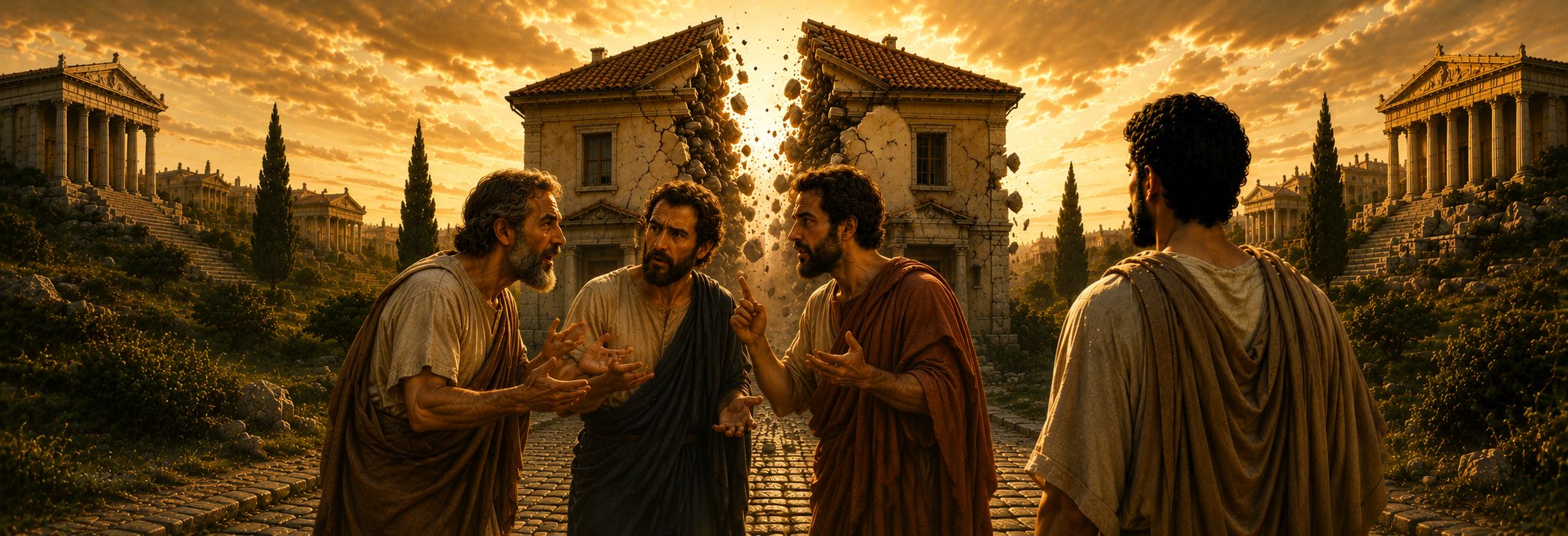
The Current Establishment View - Which It Is the Editorial Policy Of EpicureanFriends.com to Reject
Section titled “The Current Establishment View - Which It Is the Editorial Policy Of EpicureanFriends.com to Reject”With only a few notable exceptions, practically every modern account of Epicurean ethics repeats the same claim: Epicurus divided pleasure into two distinct kinds, ranked one above the other. Pleasure, like a house, cannot stand if it is divided against itself — and that is exactly the structure this traditional reading imposes on it. On this traditional view, kinetic pleasure covers everything ordinarily meant by the word — the pleasures of taste, sex, sight, hearing, and touch — while katastematic pleasure names a separate, higher condition: aponia (freedom from bodily pain) and ataraxia (freedom from mental disturbance). The kinetic pleasures are treated as a lesser, almost tolerated class; the katastematic condition is treated as the actual good, a state of katastematic supremacy that allegedly Epicurus really had in mind when he named pleasure the goal of life.
This view usually also leads to the assertion that Epicurus’s ultimate goal should be understood to have been “tranquility” or “ataraxia.” Various similar terms are also arrayed to argue that Epicurus’s true goal was not pleasure as a normal person understands that term at all, but a state of calm or relief from pain very similar to that which is advocated by Buddhism or Stoicism. In a striking number of cases the word “pleasure” itself disappears from the discussion, and those who supposedly are advocating for Epicurus essentially bury the single term with which he was most identified in the ancient world by those who knew him best. The sad result of this situation is that a large majority of videos and articles published about Epicurus today make him into an advocate for minimalism, asceticism, resignation and withdrawal - the opposite of the way the ancient Epicureans in fact lived.
It is the editorial policy of EpicureanFriends.com to reject that construction of Epicurus and the conclusions to which it leads. It is the purpose of this article to explain the foundations of that policy. Incorporated here are some - but far from all - of the points raised by several prominent academic authorities that support our editorial decision. Readers should refer to the full originals of those works for more background.
The katastematic supremacy position leans heavily on an interpretation of arguments found primarily in Cicero’s De Finibus, where the Epicurean spokesman Torquatus defends Epicurus by holding that Epicurus included within the concept of pleasure both “active” pleasure that “moves nature itself with a certain sweetness” as well as a second, “static” pleasure “perceived when all pain is removed.” This inclusive language mirrors that of Diogenes Laertius, who also records that Epicurus embraced both types of pleasure. As to Cicero, it is important to observe that he does not argue that Epicurus was in fact elevating katastematic pleasure to supreme status. Cicero’s only argument is that Epicurus was in Cicero’s view being inconsistent and illogical in considering two very different things under the single name of pleasure, and that if Epicurus had been more consistent in advocating the merits of “absence of pain” he would have adopted the position of the philosopher Hieronymus who explicitly elevated a goal of absence of pain as supreme and as a result rejected pleasure.
Gosling and Taylor, writing independently and from a different angle than Nikolsky two decades later, conclude that the katastematic supremacy picture advocated by many modern scholars is not just questionable in its details but wrong in its basic shape: Epicurus never intended kinetic and katastematic pleasure as two competing kinds standing in a hierarchy, one subordinate to the other. Pleasure, for Epicurus, is one thing — the supreme good — not two competitors yoked awkwardly under a single name.
Cicero’s Own Test Case: Hieronymus of Rhodes
Section titled “Cicero’s Own Test Case: Hieronymus of Rhodes”The argument that follows in this section is independent of both Gosling and Taylor and Nikolsky. Neither scholarly work discusses it, and it should not be read as attributed to them. It is drawn directly from Cicero’s own words of the point introduced already: that Cicero charged Epicurus with inconsistency in language, not with actually elevating a separate katastematic good to supremacy over pleasure. Cicero knew that Epicurus did not do that, because he knew of another philosopher - totally separate from Epicurus and the Epicureans - who had done exactly that.
Cicero did not have to speculate about what a philosopher who genuinely made “freedom from pain” the supreme good, to the exclusion of pleasure, would sound like. He had a real example directly in front of him: Hieronymus of Rhodes, a Peripatetic philosopher who lived after Epicurus (approximately 290-230 BC) and who had Epicurus’s own writings available to him when he staked out his position. Hieronymus is not a figure Cicero mentions once in passing. He names him, and explicitly contrasts him with Epicurus, in at least three separate works.
In the Academic Questions, listing the various schools by their stated goals, Cicero places Epicurus and Hieronymus in two distinct categories in the same sentence: “After him came Epicurus, whose school is now better known, though he does not exactly agree with the Cyrenaics about pleasure itself. But Callipho thought that pleasure and honor combined made up the chief good. Hieronymus placed it in being free from all annoyance.”
In the Tusculan Disputations (Book II), Cicero again treats the two as sequential but distinct positions: “After him Epicurus easily gave into this effeminate and enervated doctrine. After him Hieronymus, the Rhodian, said, that to be without pain was the chief good, so great an evil did pain appear to him to be.”
Later in the Tusculan Disputations (Book V), Cicero lists the competing “simple” definitions of the good side by side, naming Epicurus and Hieronymus as two of the four: “‘nothing good but pleasure,’ as Epicurus maintains: ‘nothing good but a freedom from pain,’ as Hieronymus asserts.”
In De Finibus (Book II) — the very dialogue on which the katastematic-supremacy reading is built — Cicero brings up Hieronymus directly against Torquatus, in the same conversation already discussed above regarding “absence of pain” and pleasure. He asks Torquatus why, if Epicurus meant the same thing Hieronymus meant, he did not simply use Hieronymus’s term: “if he means the same thing that Hieronymus does, who thinks that the chief good is to live without any annoyance, why does he prefer using the term ‘pleasure’ rather than freedom from pain, as Hieronymus does, who is quite aware of the force of the words which he employs?” A few pages later Cicero presses the same point even more explicitly, stating plainly that Hieronymus’s position and Epicurus’s are not the same thing at all: “nor does Hieronymus, who lays it down that freedom from pain is the chief good, ever use the word ‘pleasure’ for that painlessness, inasmuch as he never even reckons pleasure at all among the things which are desirable.”
Independent, non-Ciceronian confirmation exists as well: Clement of Alexandria, in the Stromateis (Book II, Chapter 21, sections 127-128), records the same ancient division of philosophical schools by their stated goals, placing Epicurus in the category of philosophers who named pleasure as the end and Hieronymus in the separate category of those who named freedom from pain as the end. This matters because Clement’s testimony does not come from Cicero’s dialogues or from the same rhetorical context at all — it is an independent tradition arriving at the identical classification.
The logical structure of this evidence is what makes it decisive. Cicero was not confused, careless, or working from secondhand rumor about what “freedom from pain as the supreme good, with pleasure excluded” actually sounds like when a philosopher genuinely holds it. Cicero had Hieronymus sitting right there in the historical record as his working example, and he cites him by name, repeatedly, across three different works, specifically to make the contrast vivid. If Epicurus’s real position were what the katastematic-supremacy reading claims — that “absence of pain” is a separate, superior good and pleasure a secondary, tolerated one — then Epicurus’s position and Hieronymus’s would be the same position, and Cicero’s own favorite rhetorical weapon against Epicurus (repeatedly holding up Hieronymus as the philosopher who says the same thing correctly and consistently) would make no sense. You cannot fault someone for failing to be as clear and consistent as a rival philosopher if that rival philosopher secretly holds your subject’s own true position. Cicero’s argument only works, on its own terms, if he understood Epicurus and Hieronymus to be saying two genuinely different things — which means Cicero himself, however hostile a witness, did not take Epicurus’s actual claim to be the katastematic-supremacy position at all. His charge was that Epicurus muddled a single word (“pleasure”) to cover two things that Hieronymus, more consistently, kept separate and named honestly. That is a charge of poor terminology, not a report that Epicurus secretly agreed with Hieronymus about what the good actually is.
One further point deserves mention. Hieronymus came after Epicurus and had access to his writings. If “absence of pain, to the exclusion of pleasure” really were Epicurus’s own considered position, Hieronymus’s entire philosophical contribution collapses into restating, more baldly, something Epicurus had already said — and no ancient source treats it that way. Instead, the sources treat Hieronymus as staking out his own distinct position, one later and different from Epicurus’s, not as a mere clarification of it. The ancient world drew this line carefully and repeatedly. Modern readers who attribute the katastematic-supremacy view to Epicurus are, in effect, quietly handing him Hieronymus’s position instead of Epicurus’s own — exactly the error this article, and the editorial policy explained at its close, exists to correct.
Why The Place of Pleasure Matters
Section titled “Why The Place of Pleasure Matters”This is not a narrow philological quarrel over the fine print of a single Greek adjective. The katastematic-supremacy reading is the technical hinge on which a much larger and more consequential distortion turns: the claim, repeated across centuries and still dominant today, that Epicurus’s real goal was not pleasure at all but tranquility. Once a reader accepts that Epicurus quietly ranked a separate, non-sensory “static” pleasure above the ordinary pleasures of taste, friendship, sex, and delight, the door is open to treating that static condition as something categorically different from pleasure as anyone actually experiences it — and from there it is a short step to renaming it “ataraxia,” then “tranquility,” then “equanimity” or in more modern terms as “relief from pain” or “homeostasis” — until the word pleasure itself quietly disappears from the account and Epicurus has been rebuilt, feature by feature, into a Stoic or a Buddhist wearing a Garden name tag. Tracing the actual textual history of this specific error — who first read Cicero’s Torquatus as establishing a hierarchy rather than a unity, and why — is therefore not a detour from the ethical question of what Epicurus actually taught about how to live.
The historical record shows that strong motivation existed to rewrite Epicurus long before modern commentators gave the katastematic-supremacy reading its current academic respectability. Lorenzo Valla’s 1431 dialogue On Pleasure and, later, Pierre Gassendi’s seventeenth-century Catholic revival of Epicureanism (popularized in English by François Bernier) both tried to reconcile a philosophy of pleasure with Christian asceticism, and both found their opening in exactly this argument: elevate “absence of pain” into a separate, higher, more respectable category, detach it from the pleasures of the body and the senses, and rename it something closer to “peace of mind.” Tellingly, the sources least infected by this move — Cosma Raimondi’s frank Renaissance defense of Epicurus, or Frances Wright’s 1822 Benthamite popularization — are precisely the ones with no theological or Stoic motive to launder pleasure into tranquility. The pattern holds from antiquity to the present: wherever a commentator has an independent reason to prefer a philosophy of calm withdrawal over a philosophy of active pleasure, the katastematic / kinetic distinction is trotted out to be led around like a pony at a circus as a tool that gets them where they want to go.
The cost of this misreading is not simply rhetorical. If “absence of pain” names a separate and superior good, detached from the ordinary pleasures Epicurus spent his life defending, then a life of minimalism, resignation, and withdrawal from active engagement with food, sex, friendship, and the senses becomes not just compatible with Epicureanism but its most consistent expression. This is exactly backwards from how Epicurus’s own students lived, how Torquatus describes the goal in Cicero’s own dialogue (“numerous and vivid pleasures alike of body and of mind”), and how Diogenes of Oinoanda summarized his life’s work on his dying stone inscription: not a retreat from pleasure but “a fine anthem to celebrate the fullness of pleasure.” Restoring the single-good reading defended in this article — pleasure as one thing, described from the angle of its cause (kinetic), its limit (aponia), and its resulting condition (katastema), rather than two things ranked in a hierarchy — is what closes off this misreading at its technical source rather than merely contesting its conclusions.
This is also why the point connects directly to Principal Doctrines 3 and 18, which state that pleasure has a limit, reached when all pain is removed, beyond which pleasure can vary but not increase. Seen through the katastematic-supremacy lens, that limit looks like a ceiling on ordinary pleasure in favor of something else, quieter and higher. Seen correctly — as the completed result of pleasure, not a rival category — the limit is not a demotion of pleasure but its completion: a full cup, not an empty one. Getting the katastematic/kinetic question right is what makes it possible to see Epicurus’s doctrine of the limit of pleasure as the triumphant answer it was meant to be, rather than the quiet retreat generations of readers have been misled into accepting.
Why the Katastematic Supremacy View Doesn’t Work
Section titled “Why the Katastematic Supremacy View Doesn’t Work”Gosling and Taylor begin by cataloguing the inconsistencies the katastematic emphasis forces onto Epicurus. Four problems in particular have no good answer if kinetic and katastematic pleasure really are two separate kinds, one of them the true good and the other a secondary, almost dispensable class:
- The emphasis on sensory pleasure becomes inexplicable. If the real good is the non-sensory state of aponia/ataraxia, why does Epicurus talk as though sensory pleasure matters enormously — going so far as to say, in a passage Cicero himself quotes, that he cannot conceive of the good at all once the pleasures of taste, sex, and hearing are subtracted?
- The senses are supposed to be the criterion of the good, yet it is easy to see how a sensory pleasure is directly given in perception and hard to see how an abstract state like absence of disturbance or absence of pain could be perceived in the same way. If katastematic pleasure is a different, non-sensory kind of good, Epicurus’s own epistemology makes it strangely inaccessible to the very faculty he says reveals the good.
- The “cheating” charge. If aponia and ataraxia are purely negative — mere absences of pain and disturbance — then Epicurus looks like he is quietly switching the meaning of “pleasure” mid-argument: an ordinary sense some of the time and a stretched technical sense at other times. If true, this would validate the claim Cicero made of him that Epicurus was being inconsistent and illogical.
- A living thing without any sensory pleasure at all would, on Epicurus’s own physics, have no perception and therefore no life. It is odd to imagine a “pure katastematic” state entirely detached from sensation, as the katastematic-supremacy reading seems to require.
None of these problems arise from any ambiguity in Epicurus’s actual words about pleasure being good — they arise specifically from the assumption that he meant two different kinds of pleasure, standing in a hierarchy, rather than one unified good described from different angles.
Pleasure Is A Single Good Described In Two Ways
Section titled “Pleasure Is A Single Good Described In Two Ways”Gosling and Taylor’s proposed alternative is that Epicurus never intended a division into competing kinds at all. Aponia is simply the condition of having sensory pleasure with no pain mixed in. Ataraxia is the confident, well-founded expectation that this painless pleasant condition will continue — a confidence secured by true beliefs about death, the gods, and the limits of desire, rather than by superstitious anxiety. On this reading, “katastematic pleasure” is not a separate, non-sensory good standing above sensory pleasure; it is sensory pleasure itself, considered under the aspect of being secure and undisturbed. The body supplies pleasure-without-pain; the mind supplies confident memory and expectation that this same condition will hold. These are not two rival goods in competition — they are two descriptions of one and the same good life.
This position dissolves all four objections at once. Sensory pleasure keeps the central importance Epicurus clearly gives it. It remains something perception directly reveals, since aponia just names painless perception itself. “Pleasure” is not being used in two conflicting senses, and there is no need to imagine a pleasure-without-perception state, since aponia was never meant to describe one.
If this is right, what is left to call “kinetic”? Gosling and Taylor answer that kinetic pleasure was meant to refer simply to the process of moving toward the goal of a painless condition — the pleasure of drinking while still thirsty, as against the pleasure of having drunk and being thirst-free. It is not a different kind of pleasure, only the same phenomenon viewed as a transition rather than as an achieved state. Epicurus would have had little theoretical reason to make a great deal of this distinction, except in specific polemical contexts where an opponent forced the issue — the question of whether pleasure can be said to have a “limit” — which is exactly the pattern the ancient evidence shows.
Which Interpretation Best Fits The Sources?
Section titled “Which Interpretation Best Fits The Sources?”The most persuasive ancient sources strongly support the single-good reading. Lucretius and Plutarch — in the latter’s case, in a dialogue expressly devoted to attacking the Epicurean life as unlivable — both discuss Epicurean pleasure at length. Neither shows the slightest sign of treating a kinetic / katastematic contrast as an important, well-known Epicurean doctrine. If the distinction had really been central to Epicurean theory, it is hard to believe both authors would have passed over it in total silence, especially since Plutarch, like Cicero, was actively hunting for weaknesses to exploit.
Cicero is the one major source for the rigid two-kinds reading, and he is also demonstrably not an honest guide to it. He is an unsympathetic critic explicitly trying to catch Epicurus in inconsistency, and he cannot even keep his own account of “motion” straight. In one passage motion means a change in the organism’s state (thirsty to not-thirsty), and in another it means physical motion in the sense organs themselves (the pleasures of taste, sound, and sight).1 If kinetic pleasure were a stable, well-defined Epicurean technical term, its chief ancient reporter should not be equivocating about what it even refers to. Nikolsky’s independent analysis of Cicero’s text, discussed below, reaches the same diagnosis from the Latin itself.
Diogenes Laertius X.136 is the passage most often treated as decisive, since it appears to quote Epicurus’s own words distinguishing katastematic from kinetic pleasure. But the text is compressed and difficult, and both Gosling and Taylor and, independently, Nikolsky argue that its most natural reading does not require two competing kinds at all — a point developed fully below.
Finally, one might object that the Cyrenaics’ known rejection of aponia as a pleasure at all (they compared it to the condition of a sleeping person) shows that contemporaries close to the debate understood Epicurus to be making exactly the two-kinds claim. But there is no real evidence the Cyrenaic position was formulated specifically against Epicurus, no evidence the Cyrenaics were careful or sympathetic readers of him, and independent reason — via Epicurus’s own teachers Nausiphanes and Pamphilus — to think his actual target in this discussion was debates already current in the Academy, not the Cyrenaics at all.
Gosling and Taylor’s reading has not remained an isolated position from 1982. Emily Austin, in Living for Pleasure: An Epicurean Guide to Life (2022) — a book aimed explicitly at general readers, exactly the audience most exposed to the popular tranquility-centered misreading this article addresses — notes in a footnote that she has deliberately chosen not to relitigate the katastematic/kinetic dispute in her main text, but that “a specialist will recognize” she is “adopting a view roughly in line with Gosling and Taylor (1982) and Arenson (2019).” On her reading, “katastematic pleasures are sensory pleasures that issue from confidence in one’s ability to satisfy one’s necessary desires and an awareness of one’s healthy psychological functioning,” while “choice-worthy kinetic pleasures are the various pleasures consistent with maintaining healthy functioning” — pleasures which vary but do not increase functioning beyond it.
The Arenson citation traces to her book, Health and Hedonism in Plato and Epicurus (2019). In her introduction, Arenson discusses why she sets aside much of Cicero’s testimony on Epicurean pleasure. Arenson writes that her thinking “has been influenced by the work of J. C. B. Gosling and C. C. W. Taylor (1982) and Boris Nikolsky (2001),” whom she describes as “the minority of scholars who understand Epicurus’ conception of pleasure independently of Cicero’s testimony,” and states in her own words: “I share their position that what counts as properly kinetic according to Epicureans is the pleasure linked to the perceived process of restoring painless organic functioning, whereas what counts as katastematic is the awareness of the organism’s painless functioning.” She adds that she is “somewhat sympathetic” to Nikolsky’s interpretation specifically, and has “followed Nikolsky’s lead in looking to the debates within the Platonic Academy” for insight into Epicurean hedonism — an independent scholar arriving, by her own account, at something close to the same trail Nikolsky blazed from Carneades’ Academy through to Cicero. Arenson goes on to build her own further account on this shared foundation (including an argument that certain pleasures usually classified as kinetic, such as taste and sex, are better classified as katastematic), and is careful to say her book is not meant as “a defense of all their views.” But on the specific point relevant here — that kinetic and katastematic are not two competing, hierarchically ranked kinds of pleasure but two different descriptions of a single underlying phenomenon — she states her agreement with Gosling and Taylor plainly and in her own voice.
This is independent confirmation, decades after Gosling and Taylor’s original argument and from a scholar working the primary texts herself rather than relying on secondhand summary. Although a minority, there are sound academic specialists in Epicurean ethics who regard the single-good reading defended in this article as the sounder one — including, as noted above, at least one author writing for a popular, non-specialist audience, who judged it better to build quietly on that minority position than to repeat centuries of error that stand in the way of a better understanding of Epicurus.
Arenson’s book also independently confirms the practical stakes with which this article opened. She names the “passive, withdrawn Epicurus” danger explicitly, as a problem the traditional kinetic/katastematic reading creates rather than solves. Describing kinetic pleasure as “active stimulation” or “active employment of one’s bodily and mental faculties,” she observes that this makes katastematic pleasure “seem all the more lifeless in comparison,” and asks the question directly: “How would Epicureans dodge the charge that their best life resembles the state of a corpse?” (p. 140). She traces this same worry back to her book’s opening pages, where she frames it as one of the central problems Epicurean scholarship has to solve: Epicureans need “a robust response to the Cyrenaic criticism that the Epicurean good resembles the state of a corpse: dead bodies might be painless, but they certainly are not enjoying health” (p. 3). Her own resolution runs in the same direction as the argument made throughout this article: katastematic pleasure is not an inert absence but the perceived, positively enjoyed condition of an organism functioning in health — something a corpse, lacking all perception, categorically cannot have. This is an independent scholarly confirmation, in a specialist’s own words, of exactly the danger this article warns against. Read the kinetic/katastematic distinction as a hierarchy with a bare, passive absence-of-pain at its summit, and Epicurus starts to sound indistinguishable from a corpse — rather than the advocate of a full, actively pleasurable life the primary sources actually describe.
Nikolsky: The Same Conclusion By a Different Route
Section titled “Nikolsky: The Same Conclusion By a Different Route”Writing nearly twenty years after Gosling and Taylor, Boris Nikolsky pushes their skepticism about the supremacy of katastematic pleasure further. Where Gosling and Taylor still preserve something like a functional two-sided distinction — a bodily condition (aponia) and a mental confidence about it (ataraxia) — Nikolsky argues that Epicurus never focused on classifying pleasure into kinds as a matter of real importance, and that the entire “kinetic versus katastematic” framework is an artifact of later teachings that can be traced to a specific, identifiable source.
Nikolsky’s method mirrors Gosling and Taylor’s in spirit: he treats Epicurus’s own writings, Lucretius, and Plutarch as the reliable core of evidence, and treats Cicero, Diogenes Laertius, and Athenaeus — the only authors who actually assert a division into two kinds — as a separate group whose testimony needs to be explained rather than simply accepted. His first argument is the same one just noted: Cicero cannot hold “kinetic pleasure” to one consistent meaning across his own text, which is itself evidence that no such stable technical category existed for him to report accurately.
Nikolsky’s more original contribution is a positive account of what Epicurus’s technical vocabulary was actually doing. Greek philosophy before Epicurus — Empedocles, Plato’s Timaeus, and later Aristotle and the Peripatetics — had long analyzed pleasure as katastasis, restoration of the organism to its natural state. Anti-hedonists, including Plato in the Philebus and probably Speusippus, used this analysis to argue that pleasure cannot be the good: if pleasure is merely a process of restoration, then the real end is the resulting neutral state, not the process itself, and so something other than pleasure (for Plato, a kind of measure or limit; for the Academy generally, virtue) must be the true good. Nikolsky proposes that Epicurus’s choice of the similar but distinct term katastema — rather than the Academy’s own katastasis — is an answer to exactly this argument. Katastema denotes the result of restoration rather than the process, which let Epicurus fold both the process and the state it produces into a single, unified pleasure, blocking the Academic objection at its root rather than conceding that pleasure is mere becoming. On this reading, aponia is not a separate, third, oddly “neutral” kind of pleasure at all. It is simply the characteristic that marks the limit on the magnitude of any pleasure whatsoever — matching Principal Doctrine 3’s statement that “the removal of all pain is the limit of the magnitude of pleasures” — a description that applies across the board, not a special static category set against a kinetic one.
By the same logic, where Epicurus and Plutarch use “motion” language, they are describing the physical, atomic mechanism of pleasure in general — the impact of external atoms upon the organism — not marking off one distinct class of pleasures as “kinetic” against a separate “static” class. A single pleasure can correctly be called a motion (describing its physical cause), an absence of pain (describing its limiting magnitude), and a katastema (describing the resulting condition of the organism) — three descriptive angles on one phenomenon, not three, or even two, competing phenomena.
This reframing lets Nikolsky offer a cleaner reading of Diogenes Laertius X.136 than either the pro-katastematic interpreters or, in a different way, Gosling and Taylor themselves propose. Rather than classifying two kinds of pleasure, Nikolsky argues, the passage describes two coexisting aspects of any pleasure: a passive aspect — a state of the body or mind, named by aponia and ataraxia — and an active aspect — an emotional response to that state, named by chara (joy) and euphrosyne (well-being), and described with the word energeia (activity). This resolves two puzzles that the traditional reading cannot: why the passage calls only pleasures of the soul “kinetic” (because energeia specifically names the soul’s active response, not a rival sensory category), and what energeia is doing in the sentence in the first place (marking the active side of the very same state whose passive side is aponia and ataraxia). Nikolsky supports this with Plutarch’s own habit of pairing aponia/ataraxia with chara/euphrosyne as two sides of a single thing, never as opposed alternatives — and situates the whole framework against the Peripatetic debate over katastasis versus energeia, in which Aristotle and the author of the Magna Moralia had already discussed bodily restoration and the soul’s active enjoyment of it as two aspects of one pleasure-event, precisely the model Epicurus adapts and then pushes further by insisting that the bodily state of restoration itself, not merely the soul’s active enjoyment of it, also counts as genuine pleasure.
Nikolsky also dissolves what looks like Epicurus’s most damaging apparent contradiction: the passage, quoted by both Cicero and Athenaeus, where Epicurus says he cannot conceive of the good apart from the pleasures of taste, sex, hearing, and sight — offered by both authors as proof that Epicurus inconsistently calls kinetic pleasure the supreme good when he elsewhere calls static pleasure supreme. Both authors, Nikolsky observes, quote only part of the passage. The fuller version, preserved by Cicero himself elsewhere in the Tusculan Disputations, shows Epicurus explicitly linking these sensory pleasures together with freedom from pain as a single, unified conception of the good — not opposing one to the other. The contradiction is an artifact of selective quotation, not a real inconsistency in Epicurus’s own thought.
Where the Error May Well Have Originated
Section titled “Where the Error May Well Have Originated”Nikolsky’s most distinctive contribution is not just a better reading of the evidence but an account of how the mistaken tradition may have originated in the first place. He traces the “two kinds of pleasure” doctrine to the divisio Carneadea — a classification scheme devised in the Hellenistic Academy, associated with Carneades and his successors, that catalogued rival philosophical theories of the highest good using a thesis–antithesis–synthesis structure for teaching purposes. In that scheme, the Cyrenaics were filed under “pleasure in motion,” other philosophers who held painlessness to be the good were filed under “absence of pain,” and Epicurus was then mechanically classified as synthesizing the two — producing an artificial doctrine of two kinds of pleasure attributed to him that reflects the Academy’s own naming convenience rather than his actual position. Nikolsky traces this scheme’s transmission through Antiochus of Ascalon into Cicero, whose four-part treatment of Epicurean ethics in De Finibus Book I mirrors Antiochus’s own four-part analytical framework point for point, and, independently but from the same underlying Academic tradition, into the structure of Diogenes Laertius’s overview of Epicurean ethics in Book 10. This is the crucial point: Cicero’s and Diogenes’s apparent agreement on the classification is not independent corroboration at all. Both descend from the same single source, transmitted along two different paths from the same Academic tradition. Diogenes Laertius had no reason to attack Epicurus and so cites it matter-of-factly as uncontroversial. In contrast, Cicero — in his own mind — had every reason to attack Epicurus, so he attempts to turn a useful distinction into a damaging contradiction.
Conclusion - Pleasure Is A Single Unified Concept Viewable From Multiple Perspectives
Section titled “Conclusion - Pleasure Is A Single Unified Concept Viewable From Multiple Perspectives”Two independent lines of argument, separated by two decades of scholarship and reaching their conclusions by different routes, converge on the same result. Epicurus did not teach that pleasure comes in two kinds standing in a hierarchy, one merely tolerated and the other alone truly good. Gosling and Taylor show that the traditional reading generates avoidable, artificial problems, and that the ancient sources most likely to know better — Lucretius and Plutarch — show no sign the distinction mattered to Epicurean theory at all. Nikolsky goes further, showing not only that the classification lacks good evidence but where the bad evidence actually came from: a scholastic naming convention invented in the Academy for comparing rival schools, mistakenly transferred back into Epicurus’s own words by Cicero and, by a separate route from the same source, by Diogenes Laertius.
What remains, once the traditional hierarchy is cleared away, is a simpler and more consistent picture. Pleasure is the supreme good — one good, not two. Hedone, kinesis, aponia, and eustathes katastema are different terms describing different characteristics of a single phenomenon: an external influence acting on the organism and bringing it into its natural, painless state. Aponia names the limit that gives pleasure its maximum magnitude; kinesis names its physical, atomic mechanism; katastema names the resulting condition of the organism experiencing it. None of these terms mark off a separate, superior kind of pleasure set against an inferior one. Epicurus’s insistence that sensory pleasure matters immensely, and his simultaneous insistence that the complete absence of pain is the greatest pleasure there is, were never in tension to begin with — they are two descriptions from different perspectives of the very same supreme good.
The Editorial Policy at EpicureanFriends.com
Section titled “The Editorial Policy at EpicureanFriends.com”Having traced the argument to this conclusion, a practical question remains: how much further debate about it belongs at EpicureanFriends. The debate is old, technical, and — as the history traced above shows — it has repeatedly proven to be exactly the kind of debate that those with a Stoic, Buddhist, or ascetic agenda can use, whether deliberately or not, to consume disproportionate attention by relitigating a question that should never have arisen. That overconsumption of time is a cost EpicureanFriends is not willing to pay. A community dedicated to the study and promotion of Epicurus cannot allow one dubious but recurring argument, whatever its pedigree, to crowd out the far larger body of work still to be done in the study and promotion of the philosophy as a whole. Likewise we cannot allow that argument to be used, yet again, as the mechanism by which the philosophy is converted into its own opposite.
Good-faith discussion of the katastematic/kinetic question is therefore welcome here, but only within real limits. Posts that simply restate the katastematic-supremacy position, or that use it as a wedge to reintroduce tranquility, equanimity, asceticism, minimalism or even the term “absence of pain” as some good superior to and distinct from pleasure, will be moderated closely depending on their character. Neutral or exploratory posts on the topic that are not themselves advocacy for the position adopted here will be strictly limited in number and scope. The appropriate response to such posts in most cases will be citation to this article or to the many prior discussions we have held on the subject. This ground has already been thoroughly covered and re-covered, and repeating it endlessly serves no legitimate purpose. Posts that constitute active advocacy against the editorial position set out in this article — posts that argue, in effect, that Epicurus really did rank a separate katastematic good above ordinary pleasure, or that his true goal was tranquility rather than pleasure — will be heavily moderated or removed outright. Posters who persist in advocating that position will have their participation on the forum limited or terminated.
This is not a judgment made lightly or without regard for open inquiry. It is a judgment about proportion. There are too many extremely important and unfinished tasks in the study and promotion of Epicurean philosophy — and too many people to help — for this argument to be allowed to consume attention that belongs elsewhere. At EpicureanFriends the advocacy of katastematic supremacy has reached its final dead end.
Epicurus built pleasure as a single house, not two rooms at war.
Works Cited
Section titled “Works Cited”Arenson, Kelly. Health and Hedonism in Plato and Epicurus. London: Bloomsbury Academic, 2019. See Introduction, p. 4.
Austin, Emily A. Living for Pleasure: An Epicurean Guide to Life. New York: Oxford University Press, 2022. See Chapter 4, note 8.
Gosling, J. C. B., and C. C. W. Taylor. The Greeks on Pleasure. Oxford: Clarendon Press, 1982. See Chapter 19, “Katastematic and Kinetic Pleasures,” pp. 365-396.
Nikolsky, Boris. “Epicurus on Pleasure.” Phronesis 46, no. 4 (November 2001): 440-465.
Footnotes
Section titled “Footnotes”-
The two passages are both from Cicero’s De Finibus, Book II, in the course of Cicero’s own cross-examination of Torquatus. The first passage uses “motion” to describe sensory pleasure generally, the pleasures of taste, sound, and sight among them: “Because all men feel that this is pleasure which moves the senses when they receive it… [Epicurus] declares that he is unable even to understand where it is, or what any good is, except that which is enjoyed by the instrumentality of meat or drink, or the pleasure of the ears, or sensual enjoyment… for all men call that pleasing motion by which the senses are rendered cheerful, ἡδονή in Greek, and voluptas in Latin” (De Fin. II.6-7, Yonge translation). Only a few lines later, in the same conversation, Cicero uses “motion” in an entirely different sense, to mean a change in the organism’s own state from thirst to the removal of thirst: “Is there, now, said I, any pleasure felt by a thirsty man in drinking?… Is it, asked I, the same pleasure that he feels after his thirst is extinguished? It is, replied he, another kind of pleasure; for the state of extinguished thirst has in it a certain stability of pleasure, but the pleasure of extinguishing it is pleasure in motion” (De Fin. II.9, Yonge translation). ↩